

India’s circular economy moment has arrived
India’s circular economy moment has arrived
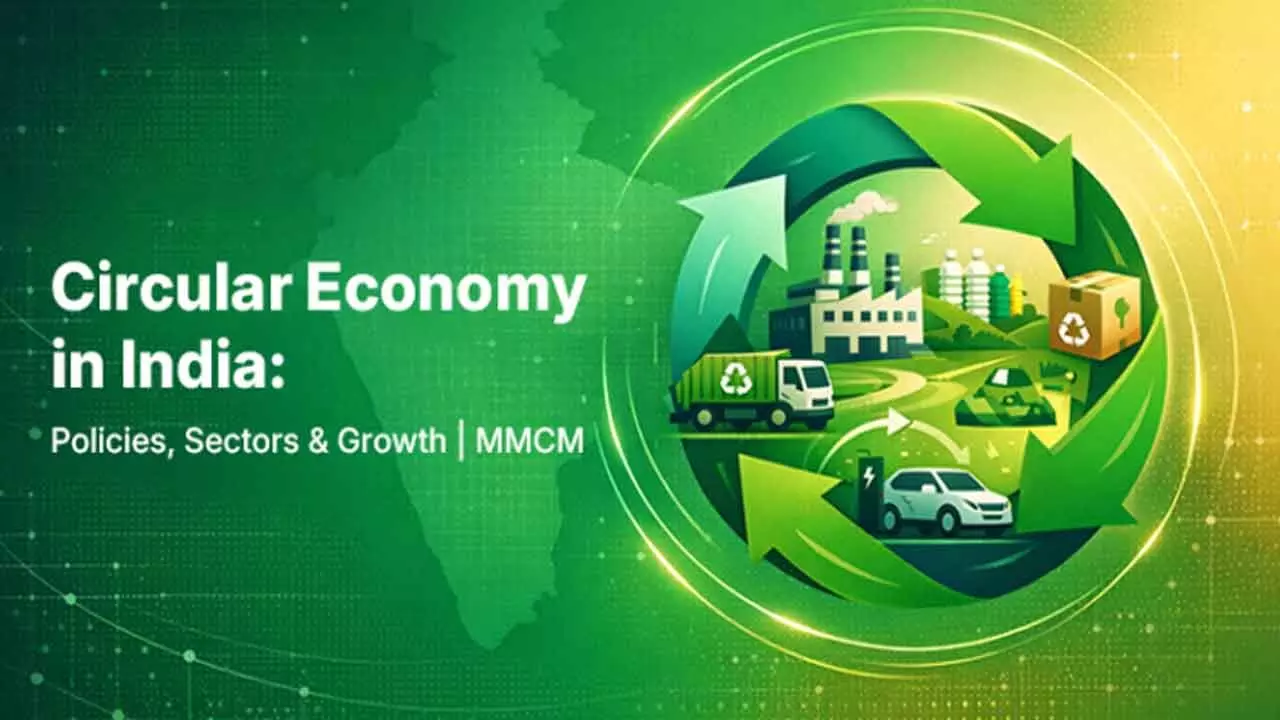
India’s march towards a circular economy has gained fresh momentum with the Centre’s decision to mandate 40 per cent recycled content in food-grade packaging from 2026–27. The move, aligned with the broader sustainability vision articulated by Prime Minister Narendra Modi, signals a decisive shift from intent to enforceable action—an inflection point that could reshape the coun-try’s plastics economy and its environmental trajectory.
At one level, the policy is a pragmatic response to a volatile global context. Supply disruptions and geopolitical uncertainties have exposed the fragility of dependence on virgin PET imports. By mandating higher recycled content, India is not merely embracing sustainability as a moral impera-tive; it is embedding resilience into its industrial architecture. Recycled PET (rPET) offers a viable domestic alternative while reducing the carbon footprint associated with virgin plastic production.
The regulatory clarity is equally significant. The guidelines issued by the Ministry of Environment, Forest and Climate Change build upon the Plastic Waste Management Rules, 2016, which envis-age a phased increase in recycled content—from 30 per cent in 2025–26 to 60 per cent by 2028–29. The provision allowing companies to carry forward shortfalls reflects a nuanced understanding of industry realities, balancing ambition with flexibility.
Crucially, the ecosystem appears ready. Earlier this year, the Food Safety and Standards Authority of India authorised 17 recycled PET manufacturing plants, unlocking a capacity of nearly 3 lakh tonnes. This is the result of sustained investments—estimated at Rs9,000–10,000 crore—in ad-vanced recycling infrastructure, aligned with global benchmarks.
Industry stakeholders have welcomed the mandate. The policy is expected to catalyse demand for high-quality rPET, fostering a robust domestic recycling market. It closes the loop on plastic use, transforming waste into a resource and creating a cycle in which collection, processing, and reuse reinforce one another.
Yet, the success of this transition will depend on execution. The availability of feedstock, post-consumer PET wast, remains uneven. Strengthening collection systems, integrating informal waste pickers into formal supply chains, and investing in segregation infrastructure will be critical.
There is also a need for sustained consumer awareness. Circularity begins at the point of disposal. Households, urban local bodies, and businesses must internalise segregation and recycling. Organi-sations such as the Association of PET Recyclers Bharat have a vital role in bridging this gap.
Legitimate concerns remain around cost pass-throughs. The transition phase may entail higher compliance costs for manufacturers. Policymakers must remain attentive, offering support where necessary to prevent inflationary spillovers.
Nevertheless, the direction is unmistakable. By mandating recycled content in food-grade packag-ing, India is sending a powerful signal: sustainability and safety are not mutually exclusive but mu-tually reinforcing. The policy elevates recycling to a central pillar of industrial strategy.
In an era defined by resource constraints and environmental urgency, India’s push towards a circu-lar plastics economy is both timely and strategic. If executed with rigour and inclusivity, the 40 per cent mandate could become a template for other sectors—and a testament to how policy, industry, and society can converge to reimagine growth without waste.





