

India @ $4 trillion: The next phase of high-growth momentum
Structural drivers continue to power sustained economic expansion
India @ $4 trillion: The next phase of high-growth momentum
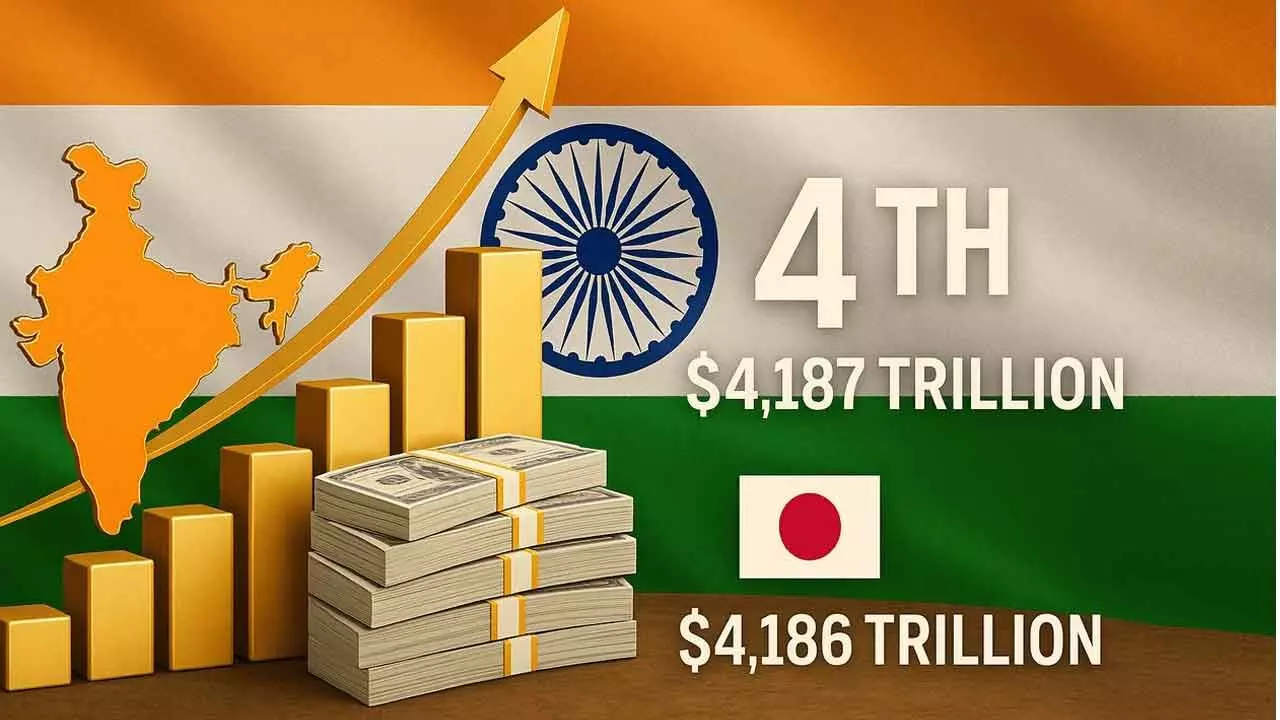
India is projected to remain the world’s fastest-growing major economy from 2026 onwards, with GDP growth expected to hold steady in the 6.4–7.0 per cent range. While this marks a slight moderation from the estimated 7.4 per cent growth in 2025, the broader trajectory remains robust. The economy is expected to cross a nominal GDP of $4 trillion in 2026, with a long-term ambition of reaching $7 trillion by 2030.
In contrast, global growth is projected at just 2.8–3.0 per cent, underscoring India’s relative outperformance. The IMF projects 6.4 per cent growth for both 2025 and 2026, while the Asian Development Bank forecasts 6.7 per cent growth for FY2025 and 6.8 per cent for FY2026. Crisil estimates a 6.5 per cent expansion in fiscal 2026.
India entered 2026 with strong economic and strategic momentum. Despite persistent geopolitical uncertainties, the key drivers that shaped 2025—resilient macro fundamentals, rising global relevance, a maturing digital economy, and a decisive shift in global supply chains—have not only held firm but strengthened. For global investors assessing capital allocation, India stands out not just for its performance, but for the durability of its structural growth drivers.
Trade developments are also shaping India’s outlook. The UK–India Free Trade Agreement, concluded in May 2025, is expected to double bilateral trade to $120 billion by 2030, while expanding access to public procurement and government contracts. More recently, the EU–India FTA, signed in January 2026, has created one of the world’s largest liberalised trade corridors. These agreements are designed to strengthen supply chain resilience, broaden market access for Indian exporters, and encourage global firms to diversify manufacturing and sourcing into India.
Together, these trade frameworks provide a more predictable regulatory environment and are likely to catalyse cross-border investment, strategic partnerships, and expansion across sectors such as automotive, pharmaceuticals, clean energy, and defence. Complementing this, Budget measures, including continued public capex, customs rationalisation, and IT-services safe harbours, aim to improve execution certainty, logistics efficiency, and capital deployment.
India’s M&A activity remained resilient in 2025, with deal volumes broadly stable and total transaction value rising to $105 billion, surpassing 2024 levels. This shift toward fewer but larger deals signals a more strategic, high-value transaction environment, supporting a positive outlook for 2026.
The digital economy continues to be a major growth engine, expanding at nearly twice the pace of the broader economy and expected to contribute close to 20 per cent of GDP by 2029–30. India remains a global leader in STEM talent and ranks second only to the US in AI skill penetration. With the fintech market projected to reach $990 billion by 2032, sectors such as AI, cybersecurity, SaaS, and digital infrastructure are poised for sustained momentum.
India’s energy transition is another key investment theme. With over 250 GW of installed renewable capacity—the fourth largest globally—and over $300 billion in investment required by 2032, the sector continues to attract strong investor interest. Green hydrogen, solar energy, and grid modernisation are central to the country’s decarbonisation and energy security strategy. Budget incentives, including customs exemptions for key inputs and streamlined approvals, are improving project viability and cost predictability.
Manufacturing growth remains underpinned by a competitive labour market, rising domestic demand, and policy support through the Production Linked Incentive (PLI) scheme. The doubling of allocations for electronics in the latest Budget reinforces this push. With increasing foreign investment, particularly from Japanese firms, India is advancing towards its goal of $1 trillion in manufacturing exports by 2030. In 2026, automotive, electronics, pharmaceuticals and defence manufacturing will remain core focal points for both strategic and financial investors.
The auto sector entered 2026 on a strong footing, following record performance across segments in late 2025. Electrification remains the standout trend, with EV retail sales rising over 16 per cent year-on-year, including a 77 per cent surge in electric passenger vehicle sales. Continued policy support is expected to sustain momentum in the EV ecosystem.
Overall, the Union Budget strikes a balance between fiscal consolidation and targeted incentives, offering greater clarity and predictability for investors. For dealmakers and global businesses, this combination of policy stability and structural growth drivers positions India as a compelling long-term investment destination.





