

Despite global economic instability, India’s economy is moving forward strongly
Despite global economic instability, India’s economy is moving forward strongly
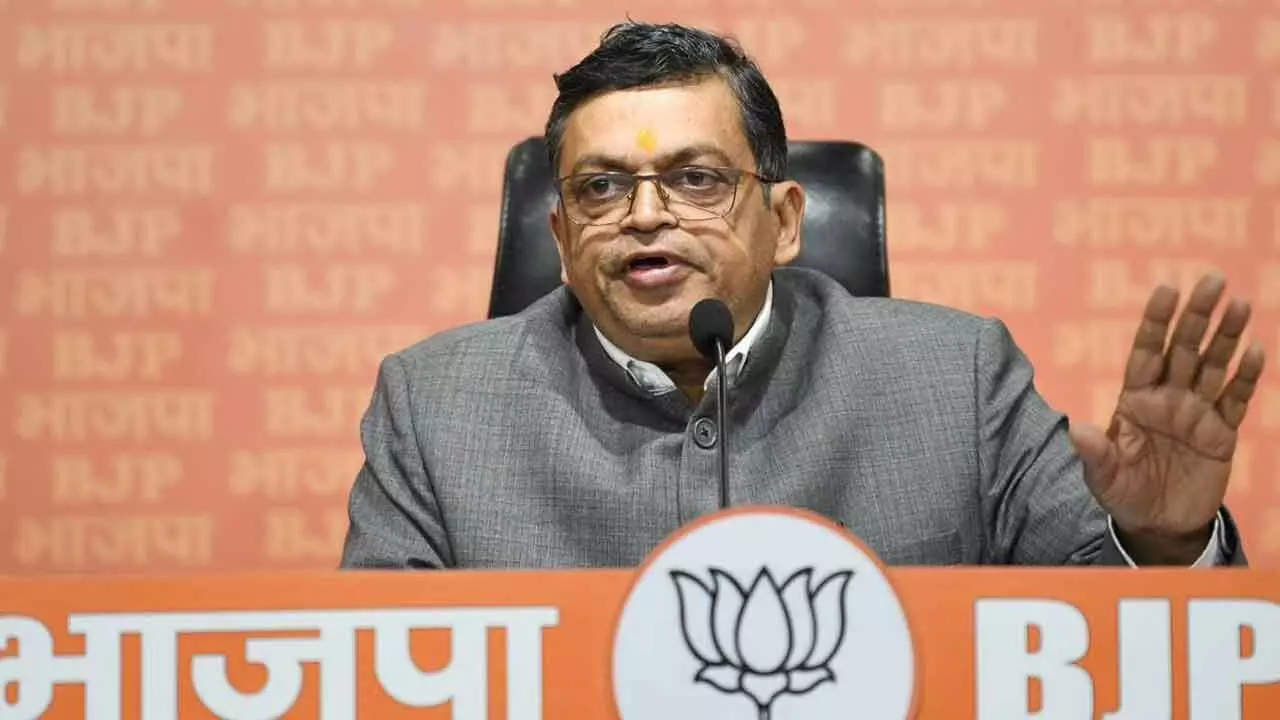
Bharatiya Janata Party National Spokesperson, Gopal Krishna Agarwal addressed a Press Conference at the BJP’s Central Office in New Delhi on Thursday. Addressing the press conference, Agarwal stated that despite global economic instability, India’s economy is moving forward strongly under the leadership of Hon’ble Prime Minister Shri Narendra Modi Ji.
According to the Advance Estimates, GDP growth is projected to remain at 7.54%, with strong contributions from the manufacturing, agriculture, construction, and services sectors. FDI, GST collections, and exports are at record levels, while inflation and the fiscal deficit remain under control.
With the Modi government’s continuous reforms, infrastructure investment, and focused attention on MSMEs, defence, space, and the semiconductor sector, India is rapidly progressing towards becoming one of the world’s leading economies.
Shri Gopal Krishna Agarwal highlighted that major changes are taking place in the global economy today. The economic framework that emerged after the Second World War has now completely weakened, and its very foundations are shaking. In such circumstances, the country that will emerge as a global economic power in the coming times will be the one that is able to rise strongly amid these challenges.
It is particularly significant that in this challenging global environment, India’s performance has been quite strong. The recently released GDP advance estimates clearly demonstrate how India’s economy is moving forward with strength under the leadership of Hon’ble Prime Minister Shri Narendra Modi Ji.
BJP’s National Spokesperson asserted that if the estimated GDP growth rate for the entire year is considered, it stands at 7.4 percent. A clear trend is visible in this, where the GDP growth rate was 7.4 percent in Q4 of the previous year, rose to 7.8 percent in Q1 of the current financial year, and then surpassed all estimates to reach 8.2 percent in Q2.
Thus, with GDP growth of 7.4 percent in Q4, 7.8 percent in Q1, and 8.2 percent in Q2, India’s economy has progressed rapidly. Not only is overall GDP increasing, but there is also a strong contribution from the manufacturing sector, where growth of 7 percent is estimated. The agriculture sector is showing strong growth on its own, and the rural economy is also moving ahead rapidly at 3.1 percent.
The construction sector, which is labour-intensive and extremely important for employment generation, along with sectors such as infrastructure and housing, is also growing rapidly, with an estimated growth of 7 percent. The services sector, in which India is establishing a distinct identity at the global level, has recorded growth of 9.1 percent.
Another important aspect is that private fixed capital formation, which had earlier emerged as a major challenge, is now reviving rapidly. The banking sector is strong, and there has been a significant increase in credit uptake as well. As a result, gross fixed capital formation, which was earlier a challenge, is now growing at a rate of 7.8 percent.
Shri Agarwal remarked that all the points that have emerged in the Advance Estimates are extremely important. If one looks at the current macro-economic parameters, India’s attractiveness for FDI is at its highest level and the country is receiving the highest FDI inflows so far. Despite major reductions in indirect taxes under the government’s next-generation GST reforms, monthly GST collections are consistently rising. In the month of December, GST collection stood at ₹1.77 lakh crore.
At the global level, protectionism is increasing and the world economy is facing multiple challenges in the form of trade and tariffs. Despite these external challenges, India has effectively and resolutely overcome them and recorded its highest-ever exports of $419 billion between April and September, that is, in the first half of the financial year. This clearly shows that India is confronting external challenges with strength and resilience.
Shri Gopal Krishna Agarwal remarked that for the common citizen, the inflation rate is the most important issue, and on this front too the situation is satisfactory. Whether it is food inflation or overall inflation, it is below 1 percent and currently stands at 0.71 percent.
Along with this, the fiscal deficit which is a key macroeconomic indicator of the strength of an economy is also under control. The Reserve Bank of India and the government had set a target of keeping the fiscal deficit below 4.5 percent, and according to the Advance Estimates it is expected to remain at 4.4 percent.
This achievement has come at a time when the previous budget saw a major reduction in direct taxes and the basic tax exemption limit was increased to nearly ₹12 lakh, impacting annual direct tax collections. Despite this, along with reductions in Goods and Services Tax rates, India’s economy is moving forward with strength and is rapidly progressing towards becoming the third-largest economy.
BJP’s National Spokesperson stated that yesterday, through his tweet, Hon’ble Prime Minister Shri Narendra Modi Ji highlighted the important point that it is essential to sustain GDP growth by continuing to move India’s “Reform Express” forward, and that this will require continuous reforms.
Hon’ble Prime Minister Shri Narendra Modi Ji has clearly expressed his commitment that India’s Reform Express will keep moving ahead and that the NDA government’s policies on the economic front will remain dedicated to strengthening the economy in a comprehensive manner.
Whether it is the government’s investment push through public sector undertakings or the direct expenditure being undertaken by the central government on infrastructure, the government is consistently working towards creating demand stimulus and has been successful in doing so. When consumer demand and rural demand increase in the economy, investment naturally follows and the economy accelerates.
The infrastructure growth story is evident to all, with rapid construction of roads, new airports being built, and expansion of waterways. Along with this, strong encouragement is being seen in the manufacturing sector, especially in the micro, small, and medium enterprises sector.
Under this targeted support being provided to MSMEs and manufacturing, certain sectors have been identified that are growing rapidly and are playing an important role in establishing India at the global level.
Shri Agarwal highlighted that the country is moving rapidly ahead in the defence sector, with private investment steadily increasing. At present, around 70 percent of the defence sector’s domestic requirements are being manufactured within India itself.
Along with this, significant momentum is also being seen in space technology and the space sector, where more than 100 startups are emerging as new industries within the space ecosystem. The government has opened the defence and space sectors extensively to the private sector, and recently, through a SHANTI Bill, the nuclear sector has also been opened to private investment.
The government is focusing on strategic and critical sectors such as nuclear energy, space technology, defence, and semiconductors so that the country’s economy can grow at an even faster pace. At the same time, digital transactions in the country are increasing rapidly.
Hon’ble Prime Minister Shri Narendra Modi Ji has a special focus on “Ease of Doing Business,” under which deregulation commission for administrative reforms been constituted. This commission will provide suggestions to create a corruption-free system and make administrative processes more streamlined, which will be implemented effectively.
So far, around 1,500 obsolete laws have been repealed, and more such laws that are irrelevant and unnecessary will be identified and removed in the future to make the administrative framework simpler and more effective.
Shri Gopal Krishna Agarwal stated that the notification of the labour codes has recently been issued, and in the coming period their impact on Ease of Doing Business will become increasingly visible. Through the new labour codes, special facilitation is being provided to small businesses, which will promote ease of doing business and have a positive impact on employment generation as well.
The Insolvency and Bankruptcy Code (IBC), which was implemented in 2016 along with GST as a major and important reform in the country, is now also being brought under a comprehensive amendment. Just as next-generation reforms in GST led to simplification and improvements in registration and procedures, similarly, the government is introducing mega reform amendments in the IBC as well.
To boost manufacturing, several new Free Trade Agreements have been signed. There is a clear commitment from the government and Hon’ble Prime Minister Shri Narendra Modi Ji towards continuous reforms, so that the strong macroeconomic indicators visible in the country today are able to drive the economy forward rapidly even in 2027 and provide it with even greater momentum.
BJP’s National Spokesperson remarked that India has signed a Free Trade Agreement with the United Kingdom, similar agreements have already been concluded with the United Arab Emirates, and strong Free Trade Agreements have also been entered into with West Asia and New Zealand.
All these Free Trade Agreements have played an important role in integrating India’s manufacturing sector with regional and global supply chains through bilateral trade. Through this, it is necessary to convey to the people of the country that the year 2026 has emerged as a “Goldilocks Kshan” for India’s economy.
There is a broad consensus that in 2026 the country’s economy has moved forward with major positive changes, and it is expected that this economic momentum will continue in 2027 as well. The reason for this is the clear commitment of Hon’ble Prime Minister Shri Narendra Modi Ji to continuous reforms.
The government has a strong commitment towards administrative reforms, completely eliminating corruption, and bringing full transparency into governance. In this context, the advance estimates that have emerged clearly demonstrate the strength of the country’s economy.





