

India accelerates military modernisation for 2026 with big-ticket acquisitions and AI-driven capabilities
Two-front preparedness, Integrated Theatre Commands, and rapid tech adoption un-derscore India’s evolving military strategy
India accelerates military modernisation for 2026 with big-ticket acquisitions and AI-driven capabilities
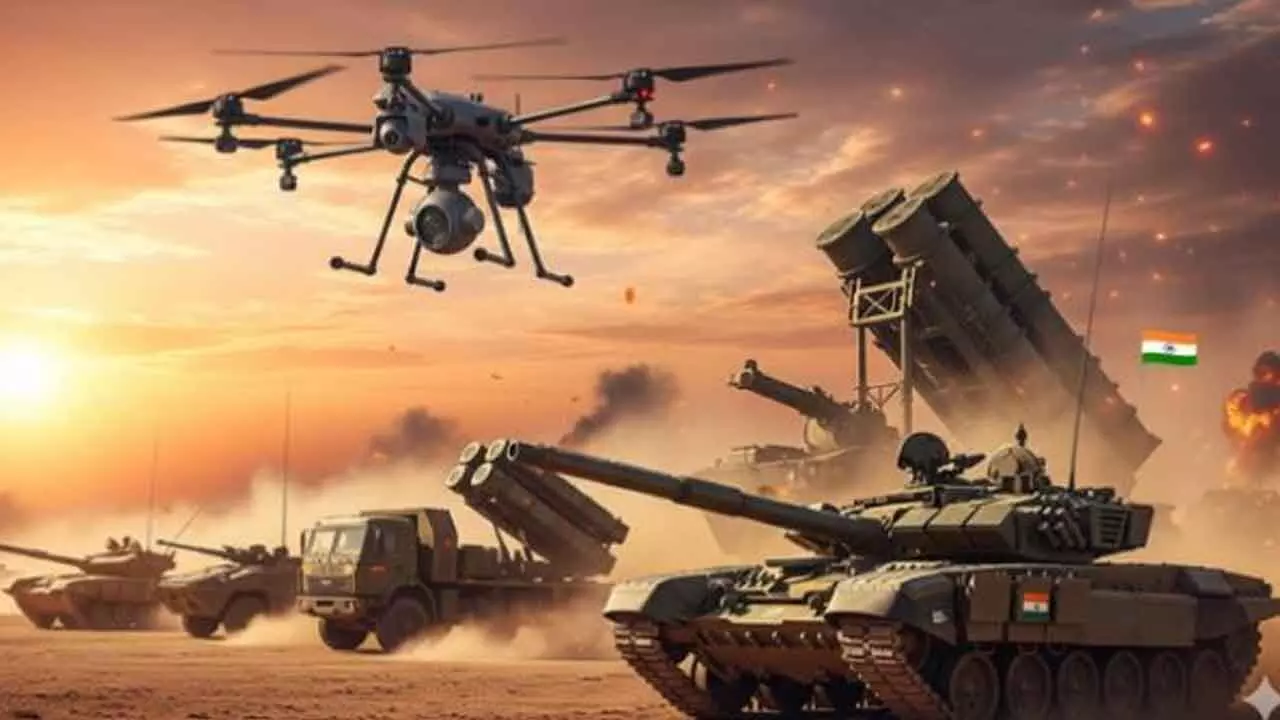
India’s defence strategy for 2026 reflects an ambitious overhaul of its military capabili-ties, combining advanced hardware acquisitions with a robust push for indigenous production and next-generation technologies. With the final S-400 squadrons on track for delivery and the planned 114 multi-role fighter aircraft deal nearing conclusion, India is deepening its convention-al deterrence.
A 13% rise in capital outlay, fast-tracked projects like the BrahMos-X missile, ma-jor naval and air force procurements, and a strong defence export target underline the nation’s self-reliance goals
India's military strategy is a multi-faceted approach that includes preparing for a two-front con-flict, modernizing forces, and leveraging technology. Key elements are the establishment of Inte-grated Theatre Commands, enhancing conventional deterrence through advanced weaponry like the Rafale jets and P-8I aircraft, and developing new capabilities in cyber and space domains.
The "Cold Start" doctrine remains a component, emphasizing rapid, limited operations against adversaries, while nuclear deterrence is a critical pillar.
Key defence activities for 2026 include India completing the delivery of the remaining S-400 air defence systems from Russia and pursuing the acquisition of 114 Rafale jets, while also working to meet a Rs 30,000 crore defence export target by March 2026.
Additionally, the UK and India plan a defence joint venture in the UAE, and a major defence budget increase is expected in In-dia for capital expenditures.
S-400 Air Defence Systems: Russia has committed to completing the delivery of the final two squadrons of the S-400 Triumf air defence system to India by 2026.
India aims to acquire 114 new multi-role fighter aircraft (MRFA), potentially the Rafale, with the deal possibly being signed in 2026. The plan involves the majority of manufacturing happening within India. Deliveries for a separate deal for 26 naval Rafale-M jets, signed in April 2025, are scheduled to begin from 2028 to 2030.
The Indian Navy's tender for four advanced Landing Platform Dock (LPD) warships, worth ap-proximately Rs80,000 crore, might see contracts finalized by 2026. If so, the first vessel delivery is projected for around 2031.
A defence joint venture between Leonardo and EDGE is planned to launch in the UAE in 2026.
Focus on Indigenous Production and Targets
India's defence budget for FY 2025-26 is Rs6,81,210 crore, with a significant 13% increase in capital outlay for new equipment acquisition. The government may also add supplementary funds to speed up local production.
India is aiming to achieve Rs30,000 crore (around $3.6 billion USD) in defence exports by March 2026.
"Make in India" Push: The government continues to emphasise indigenous manufacturing, with domestic procurement expected to rise. The value of Indian defence production is projected to exceed Rs1.60 lakh crore between 2025 and 2026.
Development of the BrahMos-X missile with enhanced speed (Mach 4.5) is being fast-tracked to meet a 2026 deadline.
Bharat Electronics Limited (BEL) is targeting a Rs30,000 crore order for the Quick Reaction Surface-to-Air Missile (QRSAM) system by 2026.
These activities are part of India's broader strategy to modernise its military and become self-reliant in defence production, while reducing dependence on foreign suppliers amid regional ten-sions.
India is strategically advancing its use of AI to strengthen its defence capabilities, enabling faster and more accurate decision-making, minimising human errors, and enhancing operational effi-ciency to address evolving security challenges.
AI is being applied in defence for various purposes, including AI-driven intercept management, predictive maintenance systems, decision intelligence, and target tracking and identification.
Advancing Military Dominance with Autonomous Systems and Robotics: The rapid develop-ment of autonomous defence systems and technologies is becoming a crucial element of military dominance.
The Indian Armed Forces are increasingly incorporating unmanned aerial vehicles (UAVs) for a variety of roles, including reconnaissance, combat, and logistics support.
Robotics technology is also gaining significant attention, with innovations like the ‘NETRA’ UAV, an indigenous unmanned aerial vehicle designed for surveillance and reconnaissance mis-sions.
Additionally, the DRDO's Remote Operated Vehicle (ROV), Daksh, serves as a versatile tool for detecting and managing improvised explosive devices (IEDs), conducting surveys of nuclear and chemical contamination, and handling hazardous materials.
Enhancing Defence with Cybersecurity and Electronic Warfare: Cybersecurity and electronic warfare (EW) are essential for detecting anomalies, countering intrusions, and adapting commu-nication protocols in real time.
The National Technical Research Organisation (NTRO) and the Defence Intelligence Agency (DIA) are investing in advanced technologies and developing specialised cyber defence units.
The electronic warfare networked command, control, communications, computers, intelligence, surveillance, reconnaissance (C4ISR), and advanced sensor systems, including those used in Op-eration Sindoor with Rafale and Tejas aircraft, enhance India's capability to disrupt enemy com-munications and radar systems.
Additionally, the DRDO has developed jamming systems like the advanced EW system ‘Shakti’.
Revolutionising Defence Manufacturing with 3D Printing: In India, one of the significant ad-vancements in defence manufacturing is additive manufacturing, particularly 3D printing, which is revolutionising defence production.
The adoption of 3D printing enables rapid prototyping and the creation of complex components, thereby reducing costs and shortening lead times for developing critical items such as missiles, UAVs, and protective gear.
Additionally, Hindustan Aeronautics Limited (HAL) and Wipro3D have partnered to 3D print metal parts for aero engines, further enhancing India's defence manufacturing capabilities.





