

Trump-backed USD1 surpasses PayPal’s PYUSD, hits $4.9 billion
Trump-backed USD1 stablecoin hits $4.9B issuance, surpassing PayPal’s PYUSD amid governance vote criticism, becoming the fifth-largest crypto stablecoin.
Trump-linked USD1 hits $4.9B, surpasses PayPal’s digital dollar
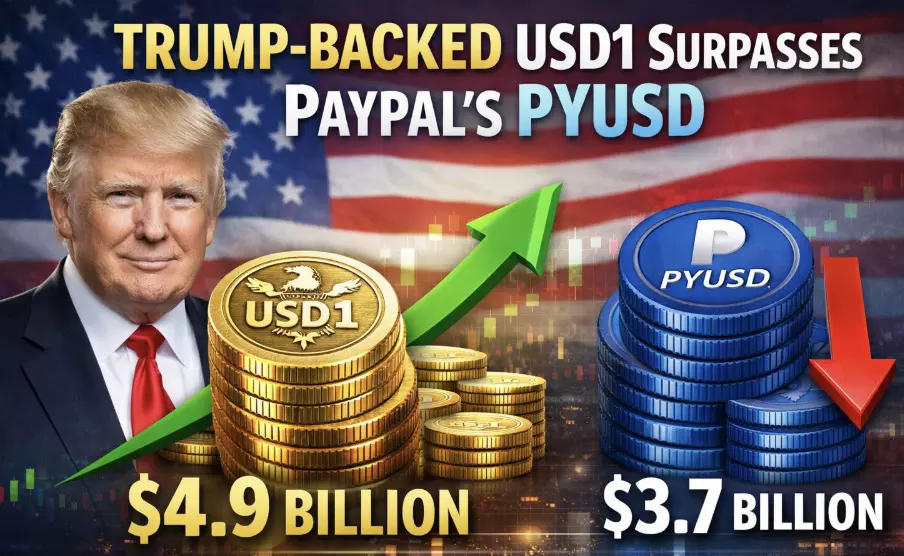
USD1, the Trump-linked stablecoin from World Liberty Financial, reached $4.92 billion in issuance, overtaking PayPal’s PYUSD. Despite criticisms over a governance vote favoring insiders, USD1 now ranks as the fifth-largest stablecoin, signaling growing influence in the digital dollar market.
USD1, a dollar-pegged stablecoin issued by World Liberty Financial (WLFI), a company co-founded by members of the Trump family, has surged past PayPal’s PYUSD in market capitalization, reaching $4.92 billion as of January 26, 2026. This milestone positions USD1 as the fifth-largest stablecoin in the cryptocurrency market, highlighting its growing prominence amid a competitive landscape.
Eric Trump, co-founder of WLFI and son of former U.S. President Donald Trump, celebrated the achievement on social media, noting that USD1’s rise represents more than a crypto milestone: “We are now larger than PayPal’s digital dollar (PYUSD) and growing into one of the most significant digital dollar platforms in the world. This isn’t just about crypto. It’s about building the future of global money. The shift is happening.”
The expansion follows a recent governance proposal by WLFI to allocate part of its unlocked treasury holdings toward supporting USD1’s growth. However, the vote has drawn criticism. According to DeFi^2, the process was “rigged” by wallets owned by WLFI’s team and strategic partners, directing protocol revenue primarily to the Trumps and the Witkoffs, as outlined in the WLFI Gold Paper. Critics argue this move disproportionately benefits insiders at the expense of regular holders.
“It’s actually as crazy as it sounds: the team is forcing a vote to sell WLFI tokens at the expense of locked holders, in order to fund protocol revenue that goes only to themselves,” DeFi^2 noted.
Despite these controversies, USD1 still lags behind industry giants like Tether’s USDT and Circle’s USDC, which together hold more than 82% of the $313 billion stablecoin market. Other notable competitors include USDS, an enhanced version of DAI, and USDe, issued by the Ethena protocol.
The surge of USD1 underscores a broader trend of increasing interest in digital dollar alternatives and politically connected financial products. While its rapid rise demonstrates market appetite for new stablecoins, regulatory scrutiny and governance transparency remain key factors for its long-term adoption.
Market observers note that USD1’s growth, though impressive, still faces challenges from entrenched incumbents and skepticism over insider-driven expansion. Analysts caution that governance controversies could impact investor confidence, particularly among those wary of centralized influence in supposedly decentralized protocols.
As stablecoins continue to evolve, USD1’s rise adds a politically charged narrative to the sector, merging high-profile branding with the growing appeal of crypto-based digital currencies. For now, USD1’s performance highlights both the opportunities and risks tied to emerging stablecoins seeking to carve out a share of the global digital dollar ecosystem.





