

India’s large market size, strong domestic demand, and political stability make it an attractive destination for global investors
Infrastructure financing is one of the safest financing segments in India, says Jyoti Prakash Gadia, MD, Resurgent India Limited
Jyoti Prakash Gadia, MD, Resurgent India Limited
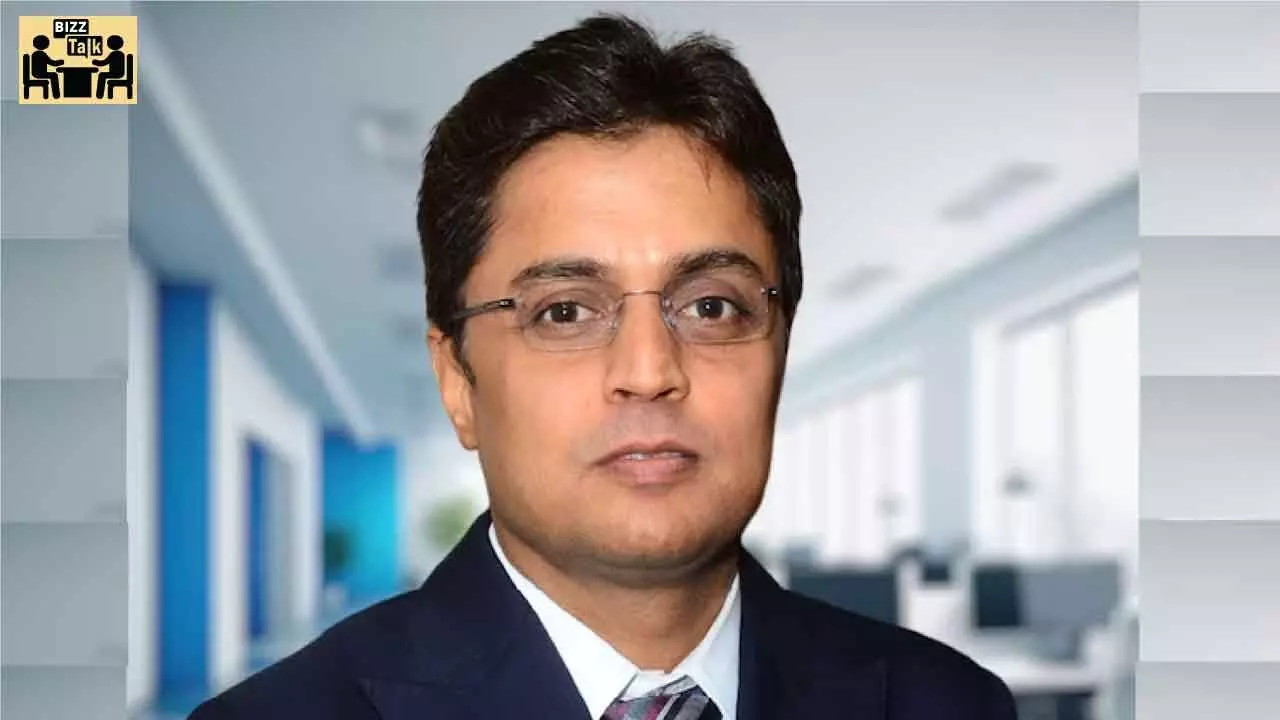
Jyoti Prakash Gadia, Managing Director of corporate financial advisory firm Resurgent India Limited, is a leading expert operating at the confluence of policy, capital, and execution. He has spent over 25 years navigating India’s most complex financial cycles—from the early infrastructure boom and the non-performing asset or NPA crisis to the emergence of a far more stable, risk-calibrated advisory ecosystem today.
With expertise in investment banking, project finance, stressed asset advisory, and PPP structuring, Gadia has advised SMEs, large corporations, lenders, global investors, and government bodies across sectors as diverse as real estate, power, highways, renewables, defence manufacturing, and urban infrastructure. His core belief is that financing cannot be divorced from business fundamentals.
Resurgent India has played role in marquee public infrastructure projects, including the Rs 1,800-crore Majestic Circle redevelopment in Bengaluru. He spoke at length with Bizz Buzz. Excerpts from the interview
You have seen India’s financial advisory ecosystem evolve over two decades. How do you assess the current maturity of India’s capital and advisory markets?
India today operates in a very different financial ecosystem compared to even 10-15 years ago. Earlier, financing often ran ahead of business models. Today, financing follows business fundamentals—and that is a very healthy shift.
Capital is available across domestic and international markets—whether it is term loans, working capital, structured debt, equity, private capital or overseas funding. But what has really evolved is the quality of appraisal. Lenders, advisors, and regulators now focus first on how the business will actually operate—how revenues will come, how risks are mitigated, how cash flows will sustain debt—before structuring finance.
At Resurgent, we are sector-agnostic. We advise real estate, infrastructure, renewables, EV, battery storage, EPC players, manufacturing, defence production, and new-age companies alike. What matters is not the sector label but whether the business model is robust, compliant, and executable. Financing is a subset of business strategy, not the other way around.
Can you explain what Resurgent India does and how it differentiates itself from conventional investment banking firms?
Resurgent India is not a product-pusher; we are problem solvers. At our core, we provide end-to-end financial lifecycle advisory. That means we support a client from the stage of conceptualising a project or business model all the way through financing, execution, restructuring, and long-term value creation.
Our work spans debt syndication—term loans, working capital, structured finance, ECBs—equity and capital markets, including IPOs and private equity, valuation services across assets, insolvency and bankruptcy advisory, and transaction advisory for PPPs and government projects.
What truly differentiates us is our ability to integrate financial advisory with ground-level execution understanding. We don’t just prepare reports; we help clients navigate regulations, compliances, lender expectations, and operational realities.
Whether it is a stressed asset requiring revival, a foreign investor entering India, or a government agency structuring a large PPP, our role is to handhold through the entire journey.
We are sector-agnostic but process-driven. If a business has potential, even if it is under stress, we provide solutions.
We work like a hospital: whether it is an OPD patient or an ICU case, we work on diagnosis, revival, and sustainability. That trust-based, long-term partnership approach is what has allowed Resurgent India to scale across sectors and geographies while maintaining credibility with banks, regulators, and policymakers alike.
Resurgent works closely with global investors. What does India need to do to attract large foreign companies faster?
Global investors don’t just look at market size; they look at the ease of execution. India has scale, demand, and political stability, which are huge positives. But foreign companies also require handholding across the entire lifecycle. When an international company enters India—whether it is manufacturing, infrastructure, or technology—it needs clarity on land acquisition, approvals, taxation, labour, environmental compliance, financing, and operational structuring. Our role is not merely arranging capital; it is handholding them end-to-end through the India journey.
India is competing globally for capital. If processes are structured smartly and timelines are predictable, the effectiveness of foreign investment improves dramatically. Speed, clarity, and certainty are now as important as incentives.
Infrastructure financing once had a reputation for NPAs. Today it is considered among the safest asset classes. What changed?
A lot changed—and it was a learning curve for everyone. In the early phase of India’s infrastructure push, business models were still evolving. Roads, power plants, ports—many projects were conceptualised before traffic studies, land acquisition frameworks, cost escalation clauses, or repayment mechanisms were fully understood.
Financing followed optimism rather than data. But if India had not taken that leap of faith, we would not have the highways, power plants, flyovers, and urban infrastructure we see today.
Over time, the ecosystem learned. The government refined concession agreements. Banks learned better appraisal and monitoring. Developers became more disciplined.
Today, infrastructure financing is one of the safest financing segments in India. In the last four to five years, there has been virtually no fresh NPA creation in new infrastructure projects. Legacy issues still exist, but new projects are far more structured and risk-mitigated.
Yet, we still see cost and time overruns in some projects. Why does this persist?
Most of these are legacy projects. Government data shows that many large projects still under stress were awarded years ago under older frameworks.
If you isolate projects awarded in the last four to five years, cost and time overruns are minimal—and even where delays occur, responsibility matrices are clearly defined. Contracts today specify who bears what risk.
Escalation mechanisms are built in. If a project is found unviable, it is scrapped early rather than allowed to bleed.
Importantly, the Ministry of Road Transport and Highways acted as a torchbearer. The learnings from roads are now being adopted by railways, power, transmission, ports, and urban infrastructure.
What role did the Hybrid Annuity Model (HAM) play in stabilising infrastructure financing?
The Hybrid Annuity Model was transformational. Earlier, the private sector was expected to absorb all the risk related to construction, traffic, financing. Now, the government itself assesses the maximum potential loss of a project and provides viability gap funding upfront.
For example, if a project costs Rs X and feasibility shows that only 60 per cent of Rs X can be serviced through revenues, the government funds the remaining 40 per cent as a grant.
Debt is raised only on the viable portion. This ensures that projects remain bankable from day one. As a result, risk-sharing is balanced, returns are predictable and financing costs come down. This is why infrastructure today attracts global capital at highly competitive rates.
Resurgent is advising the Rs 1,800-crore Majestic Circle redevelopment. What makes this project particularly challenging?
Majestic is not just a bus terminal; it is Bengaluru’s lifeline. You are dealing with a 32-acre live transit hub with lakhs of daily commuters, multiple transport agencies, metro and rail integration, commercial redevelopment, and revenue sustainability—all without disrupting daily operations.
The challenge is to create a PPP structure that balances commuter convenience, public interest, and private-sector efficiency. Phased redevelopment, traffic simulations, land-use optimisation and monetisation planning must work together seamlessly.
Our mandate is to ensure KSRTC has a financially strong, operationally viable, and commuter-centric blueprint that can attract credible private investment. We will be submitting the final project report by the end of January.
How do you ensure minimal disruption during the redevelopment of such high-footfall assets?
Operational continuity is non-negotiable. Phased construction, temporary diversions, revenue protection mechanisms, and commuter-flow management are built into the plan.
You cannot shut down a city’s nerve centre. This is where financial advisory goes beyond spreadsheets. You must understand ground realities, commuter behaviour, and institutional constraints. That is what differentiates successful PPPs from failed ones.
Has access to finance for MSMEs really improved on the ground?
Yes, and significantly for organized MSMEs. If an MSME has basic documents—GST returns, income tax filings, Udyam registration and bank statements—there is no shortage of capital today, even without collateral. Government guarantee schemes have encouraged banks to lend.
The real gap is in unorganised MSMEs that lack documentation. Financing cannot substitute for compliance. The focus now should be on educating MSMEs—helping them formalise, register, file returns, and understand basic financial hygiene. UPI has been a game-changer. Even street vendors now leave digital trails that enable lenders to assess cash flows. The ecosystem is evolving rapidly.
Delayed payments remain a big MSME pain point. What needs to change?
The law says payments must be made within 45 days, but “payment” must mean money credited to the MSME's bank account, not just accounting entries or post-dated cheques. There must be deterrence.
Delayed MSME payments should impact the credit rating of large corporations and PSUs, just like loan defaults impact borrowers. Without penalties, compliance remains weak. This single reform could dramatically improve MSME cash flows.
There is criticism that the Insolvency and Bankruptcy Board of India (IBC) has led to large haircuts. So, is IBC a success or failure?
The IBC is a success—if you understand its full impact. Nine out of ten cases are resolved even before admission, simply because of the fear of losing control of the company. That discipline did not exist earlier.
What are your expectations from the Budget 2026-27?
Two things. First, continued support for infrastructure through stable PPP frameworks and viability funding. Second, MSME reforms focused on compliance enablement, faster payments, and digital integration—not just lending incentives.
India’s growth engine is running well. The next phase is about refining systems, not reinventing them. Sustainable growth comes from strong financial architecture, transparent governance, and disciplined execution. India has learned from its past—and that learning is now paying dividends.





