

India is not just a consumer of technology; it is a laboratory of innovation—especially in storytelling
Beyond technology: ‘Jeyra’ unfolds as a complete human drama with emotional complexity and narrative tension, says Oney Seal, founder of Miami-based Seal Global
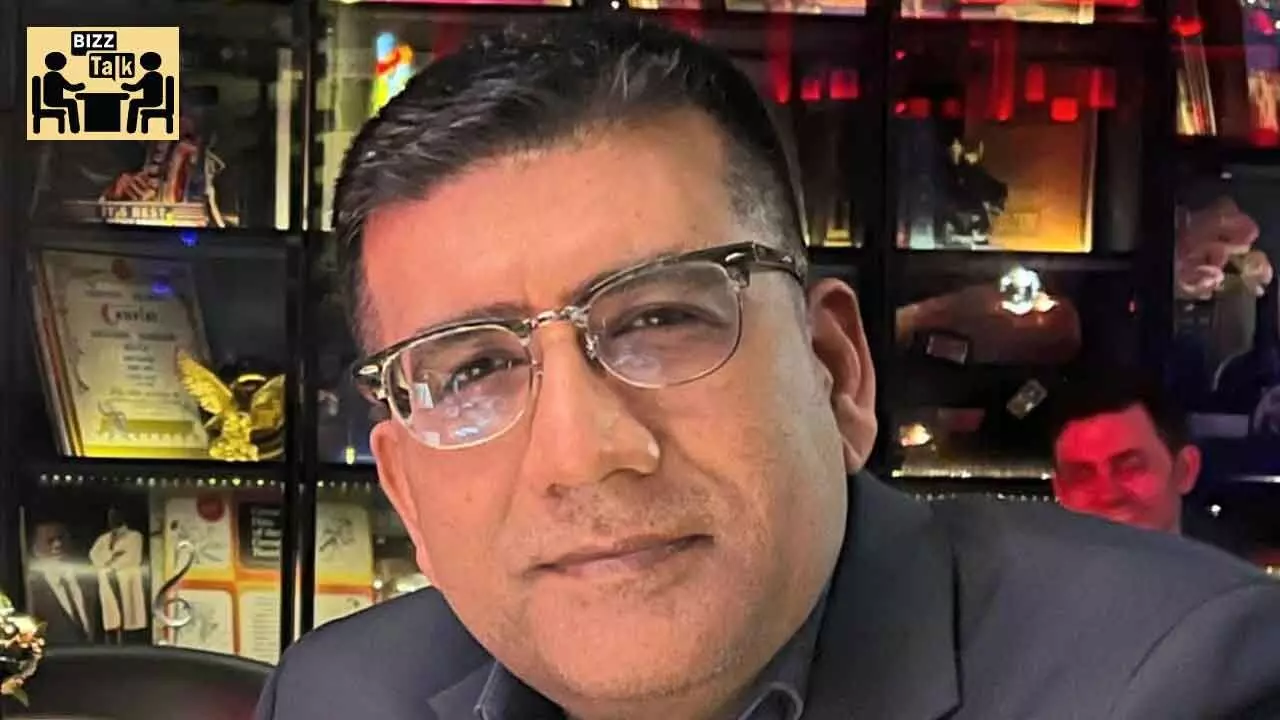
Oney Seal, Miami-based Indian-American entrepreneur, AI visionary and Founder of Seal Global
Cinema has always evolved with technology—from silent frames to sound, black-and-white to colour, celluloid to digital. Yet few shifts feel as radical as the one now unfolding at the intersection of artificial intelligence and cinematic storytelling.
That inflection point is sharply illuminated by Jeyra (The Interrogation), the world’s first AI-created Bengali microfilm, conceived by Seal Global, a US-based AI technology firm, in collaboration with its Indian arm, Databazaar Digital. Helmed by Oney Seal, Miami-based Indian-American entrepreneur, AI visionary and Founder of Seal Global, Jeyra is not animation, not a technical demo, but a full-fledged human drama—complete with emotional depth, narrative tension and cultural specificity.
In this conversation with Bizz Buzz, Oney Seal reflects on how AI is poised to democratise cinema, redefine authorship, and fundamentally alter how stories are imagined, produced and consumed. He explains why and how movie-making is at the crossroads of imagination and machine intelligence.
Jeyra (The Interrogation) has been described as a cinematic watershed. What does this film represent to you personally?
For me, Jeyra represents a threshold moment. It is the point where artificial intelligence stops being a back-end tool and becomes a front-facing creative collaborator. Personally, it is deeply meaningful because it brings together two lifelong passions—technology and storytelling.
I have always believed that cinema is not just an art form but a language of the human condition. With Jeyra, we proved that AI can engage with that language at an emotional and narrative level, not merely as spectacle but as substance.
AI has been used in animation and visual effects before. What makes Jeyra fundamentally different?
You are right—AI has appeared in cinema mostly as an assistive technology. What makes Jeyra different is that it is a full human drama, not animation in the conventional sense, and not a visual experiment.
The characters display nuanced emotions, the storytelling follows a classical dramatic arc, and the audience is invited to empathise. Until now, this was thought to be the exclusive territory of live-action filmmaking with human actors and massive crews. Jeyra challenges that assumption.
The film is in Bengali, the world’s fifth most spoken language. Was that a deliberate choice?
Absolutely. Language is identity, memory and culture. By choosing Bengali, we wanted to send a clear message: innovation does not have to be English-centric or Hollywood-centric.
AI enables us to tell deeply local stories with global reach. In fact, working in Bengali made the experiment more powerful—it demonstrated that cultural nuance and linguistic richness are not barriers but catalysts in the AI-driven creative process.
You have spoken about three scenarios that will shape the future of filmmaking. Could you elaborate on the first—the rise of the amateur creator?
This is perhaps the most exciting and disruptive scenario. AI dramatically lowers the entry barrier to filmmaking. An individual with a compelling story but without access to studios, stars or budgets can now create high-quality cinematic content.
Much like YouTube democratised video publishing, AI will democratise filmmaking. We will see voices emerging from places and communities that have historically been excluded from the cinematic mainstream.
Does this democratization threaten traditional filmmakers and studios?
I see it less as a threat and more as a rebalancing. Every technological shift in cinema—from sound to digital cameras—was initially seen as a threat. In reality, it expanded the ecosystem.
Traditional filmmakers bring experience, sensibility and depth that technology alone cannot replicate. AI does not replace creativity; it amplifies it. Those who adapt will find new freedoms, not obsolescence.
Your second scenario involves collaboration between directors and AI engineers. How does that work in practice?
Think of it as a new kind of creative partnership. The director provides vision, emotional intelligence and narrative instinct. The AI engineer translates that vision into executable parameters—visuals, pacing, performance nuances—using advanced AI tools. At Seal Global, we are already pioneering this model with a world-renowned film director.
It bridges human artistry with machine precision, creating a workflow that is both efficient and deeply expressive.
Does this change the traditional role of the director?
It expands it. The director becomes more like a conductor, orchestrating both human and machine elements. Instead of being constrained by logistical limitations, directors can focus more intensely on storytelling, mood and meaning. In many ways, it restores the director’s primacy as a storyteller rather than a manager of chaos.
The third scenario—the era of AI avatars—has sparked both excitement and anxiety. How do you see this unfolding?
AI avatars are inevitable. We already see early examples in Hollywood with digital humans like Tilly Norton. Studios will create permanent AI actors and actresses—digital intellectual properties that can be deployed across projects, languages and formats.
For studios, this offers infinite flexibility. For audiences, it introduces a new form of stardom. The ethical and legal frameworks will need to evolve, but creatively, this opens fascinating possibilities.
What happens to human actors in this future?
Human actors will remain central, especially in stories that rely on lived experience and improvisation. AI avatars will coexist, not replace. In fact, I foresee collaborations where human actors licence aspects of their likeness or performance style, creating hybrid forms of authorship. The future is not binary; it is plural.
You pioneered one of the world’s first Indian content OTT platforms, Bongflix, as early as 2009. Did that experience prepare you for this moment?
Very much so. When we launched Databazaar Media—later Bongflix—the idea of niche, language-specific OTT platforms was considered risky. Today, it is mainstream.
That experience taught me that audiences are always ahead of industry assumptions. Jeyra follows the same philosophy: trust the audience’s intelligence and curiosity.
How do you respond to concerns that AI-generated cinema may lack “soul”?
I find that concern understandable but misplaced. Soul comes from intent, not tools. A badly made human film can be soulless; an AI-assisted film, guided by thoughtful human intent, can be deeply moving. AI is a mirror—it reflects the depth, or shallowness, of the human imagination behind it.
What role does Databazaar Digital play in this ecosystem, especially in India?
Databazaar Digital is crucial because India represents both scale and diversity. Under the leadership of our President and CEO, Sudeshna Chatterjee, the team is integrating AI into content creation and digital transformation across emerging markets. India is not just a consumer of technology; it is a laboratory of innovation, particularly in storytelling.
Finally, what should audiences and filmmakers take away from Jeyra?
That we are standing at the edge of a new creative frontier. Jeyra is not an endpoint; it is a precursor. The convergence of artificial intelligence and cinematic storytelling is not just a technological evolution—it is a total democratization of the medium.
We are moving toward a world where the only limit to filmmaking is the depth of one’s imagination, not the size of one’s production budget. That, to me, is profoundly hopeful. Jeyra (The Interrogation) is currently available for global viewing on YouTube and will soon stream on Seal Global’s Amazon Prime channel, Bongflix.





