

Engineering physical intelligence: How Perceptyne is redefining industrial automation from India
India is uniquely positioned to become a global hub for dexterous humanoid robotics, Raviteja Chivukula , co founder and CEO, Perceptyne
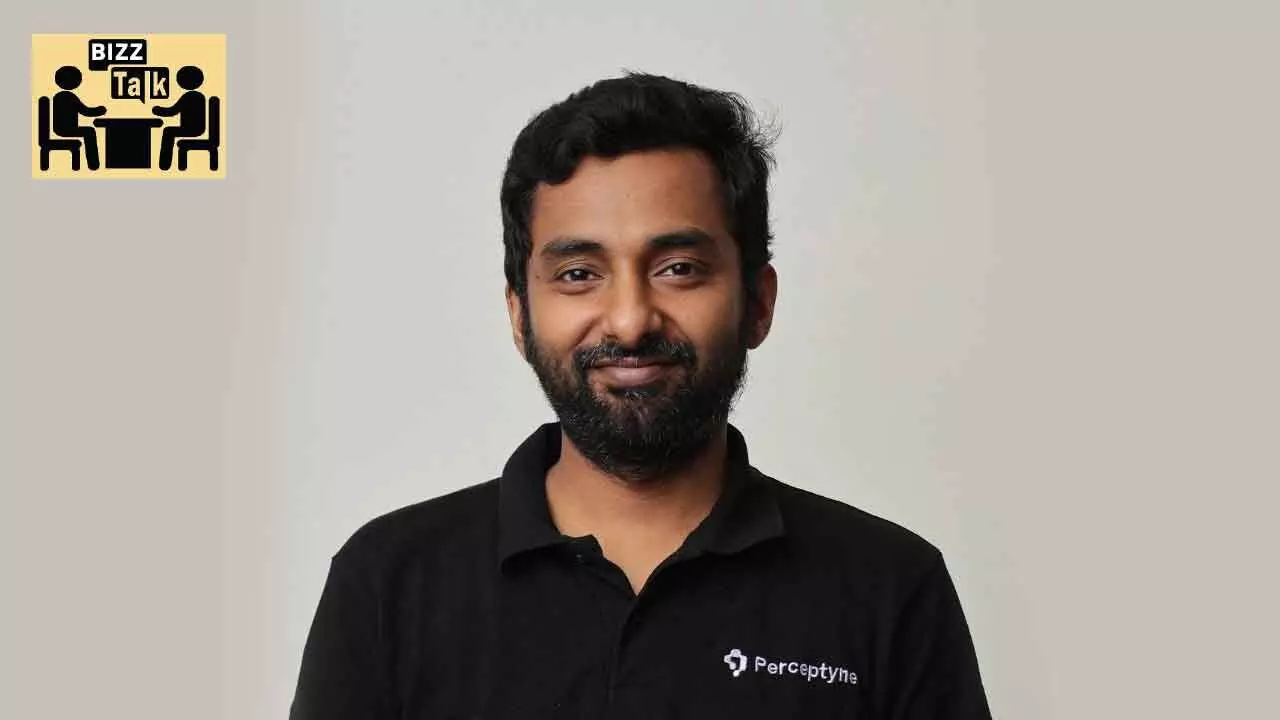
Raviteja Chivukula, Co founder/CEO, Perceptyne
As global manufacturing grapples with rising complexity, labour shortages, and the limits of traditional automation, a new wave of robotics companies is emerging to bridge the gap between human skill and machine precision. Hyderabad-based Perceptyne is one such outlier building AI-powered semi-humanoid robots designed to bring human-like dexterity to factory floors.
Founded by engineers with deep experience across aerospace, semiconductors, and autonomous systems, the company is tackling a problem few Indian startups have ventured into: Enabling robots to operate reliably in high-variability, real-world industrial environments.
Raviteja Chivukula , co founder and CEO, Perceptyne, in an exclusive interview to Bizz Buzz, said: "From electronics assembly and automotive components to warehousing and food preparation, Perceptyne’s robots are built to handle tasks once thought too complex for machines."
In the conversation,he unpacks their team's journey from identifying gaps in industrial automation to achieving early commercial adoption, while sharing insights on full-stack robotics, India’s deep-tech ecosystem, and the future of humanoid systems in global manufacturing
Perceptyne is building AI-powered semi-humanoid robots with advanced dexterity, a domain few Indian startups have entered. How did the idea originate, and what gaps in industrial automation were you are aiming to solve?
The idea came from the founders’ experience across industries, where traditional industrial robots struggled with variability, fine manipulation, and unpredictable environments, leaving critical factory tasks dependent on human dexterity.
Perceptyne was founded to bridge this gap by bringing physical intelligence to robots, enabling human-like manipulation, tactile sensing, and adaptive decision-making for precise, reliable, round-the-clock shopfloor operations
With your combined backgrounds across aerospace, semiconductor engineering, and autonomous vehicles, how have your experiences shaped Perceptyne’s approach to designing “physical intelligence” for robots?
The combined experience gave us an overall view of what was working and what was not working in automation. The traditional custom engineering automation approach worked well for low mix high volume production environments such as Coke/Pepsi bottling, biscuit manufacturing etc.
However the same custom engineering approach didn’t scale well for high mix medium volume production environments like electronics product assembly, automotive parts assembly etc.
We have realised that the only way to automate a high mix medium volume production is to have a general purpose automation system that can be quickly configured to any changes and have the hardware and intelligence capability to handle variability.
This insight is what led us to ideate a solution that resembles a human in sensory richness, form factor and intelligence.
Can we get any data on deep-tech robotics, what is the current volume of business in India and future projections?
India’s industrial robotics market is valued at $600–700 million and growing at 15–18% CAGR, driven by electronics, automotive, EVs, and warehousing, while dexterous and humanoid robotics are still in early but high-growth stages.
Globally, the humanoid robotics market is projected to reach $30 billion by 2035, with India potentially accounting for 5–10% as manufacturing scales and labour shortages rise.
Over the next decade, semi-humanoid robots are expected to see rapid adoption for high-variability tasks, making this a fast-growing deep-tech sector worldwide.
Traditional shopfloor automation struggles with dexterous, variable tasks. How does Perceptyne’s semi-humanoid platform bridge the gap between rigid automation and human-like capabilities?
Traditional industrial robots depend on fixed paths and rigid setups, failing when real-world factory conditions introduce variability.
Perceptyne overcomes this by combining dual-arm dexterity, tactile and torque sensing, vision, and adaptive AI to enable robots to handle unstructured environments and perform complex, multi-step manipulations.
This allows manufacturers to automate tasks once limited to humans, delivering human-like flexibility with the consistency of automation.
You’ve vertically integrated hardware, software, sensing, and control intelligence in-house. Why was this full-stack approach essential, and how does it differentiate you from global robotics players?
Dexterous robotics demands extremely tight integration between actuators, sensors, controllers, and AI model computers.
Off-the-shelf components don’t provide the latency required for fine closed loop control. That’s why we build everything in-house: actuators, drivers, control firmware, perception (encoders, tactile, torque), and AI. This full-stack approach gives us:
♦ Upto1kHz feedback loops for high-precision control
♦ Custom joint architectures optimised for dexterity
♦ Seamless coordination between arms, fingers, and vision
♦ Lower deployment cost and faster field customisation.
Most global players optimise for heavy-payload industrial robots or humanoids for general-purpose home tasks. Perceptyne is differentiated by designing specifically for high-dexterity, light-payload industrial environments, a segment where full-stack innovation gives us a major advantage.
Your robots are intended for general-purpose tasks but with initial focus areas like electronics, automotive components, warehousing, and food-prep. What industry trends or customer pain points informed this focus?
These sectors face shared challenges such as high variability, labour-intensive fine assembly, and rising quality standards, which traditional robots struggle to manage. Customers need automation that can adapt like skilled operators, handle small parts, and switch tasks quickly.
Perceptyne’s semi-humanoid robots address this gap by enabling flexible, dexterous automation without costly re-tooling across large global markets.
You recently closed your first purchase order with a global manufacturer of automotive electronic components. What does this milestone signal for industry adoption of dexterous humanoid systems?
This milestone signals a major shift in how manufacturers view humanoid and semi-humanoid robotic systems. It validates that dexterous robots are not just research prototypes, they are ready for real production environments.
The PO also demonstrates growing industry confidence that robots with human-like capabilities can automate tasks previously considered “too complex” for machines.
For Perceptyne, this marks the beginning of large-scale commercial adoption and strengthens our position as a global contender in humanoid robotics.
India is becoming a manufacturing hub, yet skilled labour shortages persist globally. How do you see humanoid and semi-humanoid robots reshaping industrial workforce dynamics over the next 5–7 years?
Over the next decade, humanoid and dexterous robots will become essential co-workers on the factory floor. India’s manufacturing growth will require millions of skilled operators, but industries are facing labour shortages and high churn especially in precision assembly.
FYI: The number of robots deployed for 10,000 workers in China is around 450 and in India it is around 7. For India to become a manufacturing hub like China, we need to deploy a lot more robots on our factory floors.Robots like ours will take over repetitive, ergonomically difficult, and micro-precision tasks, enabling human workers to move into supervisory, quality, and machine-handling roles.
This shift won’t replace jobs; it will upgrade them, improving productivity and safety while reducing fatigue-driven errors.
Globally, this transition is already underway. In 5–7 years, semi-humanoid robots will be a standard part of workflows in manufacturing electronics, automotive components, warehousing etc. helping manufacturers scale sustainably.
Being a deep-tech hardware startup in India comes with unique challenges —supply chain, R&D capital, ecosystem maturity. What have been some pivotal learnings in your journey so far?
A key learning is that deep-tech demands long-term conviction from founders, investors, and early customers, supported by patient capital with long investment horizons.
While the US relies on deep-pocketed VCs and China on strong policy support, it is encouraging to see India respond through initiatives like the RDI fund for deep-tech investment.
Equally critical have been vertical integration to ensure speed and reliability, a unified engineering culture across disciplines, and early backing from investors such as Endiya, Yali, and Whiteboard.
Perceptyne has filed two provisional patents with more in the pipeline. How do you balance rapid product iteration with building long-term intellectual property leadership?
We treat IP as part of product development, not an afterthought. As we prototype new actuators, tactile sensors, or manipulation algorithms, we file provisional patents early and refine them as the tech matures. This allows us to keep iterating at startup speed while securing long-term defensibility.
Our focus is on patents that strengthen core differentiators, dexterous manipulation, multi-modal sensing, joint architectures, and AI skill modules.
At the same time, we ensure that iteration cycles remain fast so we don’t slow innovation. Balancing both requires tight coordination between engineering, product, and legal teams, and a clear roadmap of what aspects of our technology must remain proprietary.
What role do you see India playing in the global humanoid robotics race, especially with companies like Perceptyne building world-class technology locally?
India is uniquely positioned to become a global hub for dexterous humanoid robotics. We have world-class engineering talent, a massive manufacturing base, and industries that deeply need automation due to variability and scale.
Companies like Perceptyne are proving that complex, full-stack robotics can be built in India at globally competitive quality and cost. As adoption accelerates, India can lead in deploying robots across electronics, automotive components, food processing, and warehousing creating a template for emerging markets globally.
As co-founders with deep technical expertise, how do you divide responsibilities across technology, business development, and scaling operations?
We divide responsibilities based on strengths while maintaining constant overlap for critical decisions. While all three of us come from strong engineering backgrounds, I take care of the hardware aspects of the technology; Mrutyunjaya is our CBO and Co-CTO, taking care of the Application software and AI pieces of the technology and business development and Jagga Raju, who is our COO, taking care of all operations, finance and other functions necessary to keep the company working.
However, real strength comes from alignment: every major product feature is discussed jointly, and customer insights flow directly back into engineering.
This ensures we don’t build research projects, we build deployable robots that solve real problems. Our structure is fluid, collaborative, and optimized for rapid iteration.
What’s next for Perceptyne? Are you planning new robot models, deeper industry integrations, or international market expansion in the near future?
Over the next 12–18 months, the focus is on scaling deployments, expanding industry presence, and launching new manipulation capabilities, particularly in electronics and automotive assembly.
Finally, for young engineers and entrepreneurs looking to build in deep-tech, what advice would you offer based on your journey from idea to commercial adoption?
Deep-tech is a marathon, not a sprint. Choose a problem worth dedicating years to—and be prepared for the long grind. The journey requires finely balancing the following dichotomies:
1. Having experience while not losing a first principles approach, 2. Working on disruptive tech while hitting the market ASAP, 3.Having a large vision while not losing attention to detail In fact, these form the core values of Percpetyne.
Build a founding team with complementary skills, with deep knowledge in multiple disciplines because most often than not, the solution to problems requires a multidisciplinary approach.
Focus on real customer pain points, not futuristic demos. The best deep-tech startups solve hard problems that industries urgently need addressed.
Raise capital from investors who understand the technology you are building and are well connected within the industry and can bring in way more value than the money they put in. Most importantly, don’t be afraid to build ambitious technology from India; global-grade innovation is absolutely possible here.





