

Building India’s next sporting economy: Abhishek Reddy Kankanala’s multi-sport vision
Beyond cricket, sports economy is still relatively small but expanding rapidly, says Chairman of Kankanala Sports Group
Abhishek Reddy Kankanala, Chairman, Kankanala Sports Group
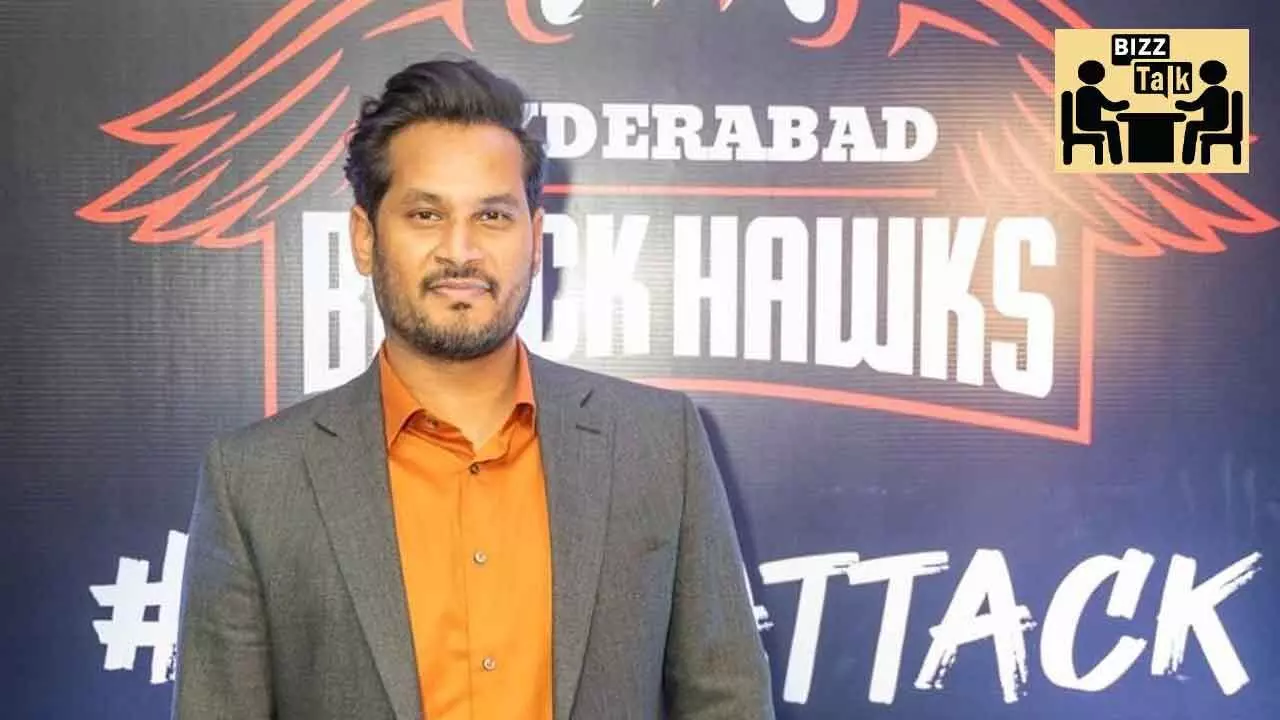
Abhishek Reddy Kankanala is emerging as a defining force in India’s evolving sports and entrepreneurship landscape, blending business acumen with a vision for global sporting excellence.
A serial entrepreneur and investor, he currently serves as Chairman of Kankanala Sports Group (KSG), which owns and operates multiple national and international teams across volleyball, handball, badminton, motorsports and poker—positioning India firmly as a multi-sport nation beyond cricket. In an interaction with Bizz Buzz, he shared his vision for the state and India’s sports in largely non-cricketing sports and games.
Under his leadership, KSG-backed INDE Racing and made history as India’s first FIM-licensed electric motorcycle racing team with podium finishes in Europe and Japan. Beyond sports, Abhishek is Co-Founder and Chief Strategy Officer of Whizzy Logistics, a rapidly scaling last-mile delivery network, and Founder of DevPixel, a US-focused Salesforce consulting firm.
A Board Member of TiE Hyderabad and President-Elect of the Global Telangana Association, he is also a strong advocate of entrepreneurship, community building and philanthropy. He also won HMTV business excellence award in the Best Entrepreneur Sports And Leagues category
How do you assess the current sports business landscape in Hyderabad compared to other Indian cities?
Hyderabad is doing phenomenally well compared to most Indian cities. While cricket operates on a rotation and quota-based system, non-cricket leagues such as volleyball and kabaddi increasingly prefer Hyderabad as a host city. This reflects the city’s strong infrastructure base.
Hyderabad has multiple stadiums, quality training venues, excellent road connectivity, and easy access to hotels near sports hubs like Gachibowli. Importantly, successive governments have provided open access and minimal administrative hurdles. Even organisers from other states come to Hyderabad to conduct leagues, which clearly sets the city apart.
What makes Hyderabad an attractive hub for sports infrastructure and sports-led businesses today?
Several parameters work in Hyderabad’s favour—existing infrastructure, relatively manageable operational costs, and ease of execution. While rising land prices will eventually pose challenges, at present Hyderabad remains far more favourable than most metros.
Leagues find it easy to operate here because facilities are available, alternatives exist during disruptions, and logistics are seamless. These factors together make Hyderabad a natural hub for sports-led businesses.
How fast is India’s sports economy growing beyond cricket?
Beyond cricket, the sports economy is still relatively small—around 20 per cent—while cricket continues to dominate nearly 80 per cent. However, the overall sports market is expanding rapidly.
From roughly Rs 52 billion in 2024, the industry is expected to grow to around Rs 130–140 billion over the next five to six years. This growth is not limited to cricket; several other sports are adopting league-based structures. Sponsorship remains a challenge, but viewership for non-cricket sports is steadily improving, which is a healthy sign.
What was the original vision behind Kankanala Sports Group, and how has it evolved?
When we started in 2021, this was never meant to be a passion project. The vision was always to build professional, structured sports organisations in India—parallel to cricket, not competing with it.
We began with badminton, boxing, handball, and later expanded into volleyball and motorsports. The idea was to put sports on television, because when children watch sports, parents follow, and participation increases. That is exactly how cricket grew in India.
Over time, the vision evolved from owning teams to building a full ecosystem—intellectual property, talent pathways, youth development, community engagement, and global exposure. Today, we are also expanding internationally through motorsports.
Which segment offers the biggest growth opportunity for your group right now?
Sports management and IP-led platforms offer the biggest opportunity. Infrastructure is highly capital-intensive with long gestation periods. Events and leagues generate visibility, but that visibility is episodic.
Management platforms and IP allow us to build long-term value. Academies are critical because they feed talent into leagues. Leagues create competition, competition builds fandom, and fandom drives commercial value. For us, building fans is central.
What differentiates Kankanala Sports Group from other emerging sports enterprises in India?
We are builders first. We do not enter sports because it is fashionable. We enter sports to build them from the ground up.
When volleyball or handball had no viable leagues, we helped create them. In motorsports, India had never had a globally competing racing team despite having millions of vehicles. We created one, and within two years, won a world championship.
Our focus is on building long-term sports institutions—developing athletes, nurturing fan bases, and creating sustainable ecosystems—rather than chasing short-term visibility.
How critical is private investment in building world-class sports infrastructure?
Private investment is absolutely critical. Governments play an important role in policy and large facilities, but private capital brings speed, accountability, operational discipline, and year-round programming.
World-class sports infrastructure requires constant maintenance, scheduling, and fan engagement. Globally, the best facilities are built through public-private partnerships, where the government enables and the private sector executes.
Are grassroots sports in India still underserved despite increased attention?
Yes, grassroots sports remain severely underserved. While attention has increased marginally, funding and facilities at the village and town level are still lacking.
For example, in countries like France, children as young as two are enrolled in racing academies. In India, fear of the unknown and lack of infrastructure prevent early exposure. Across sports, structured training from early childhood is missing.
Creating leagues helps. After launching a volleyball league, many schools were encouraged to build volleyball courts. This increased participation among children and will yield better talent over the next five to ten years.
How can private players bridge the gap between raw talent and professional sport?
India has abundant talent, but it gets lost because there is no financial security outside cricket. Athletes eventually abandon sport for studies or government jobs.
We address this by paying professional athletes competitive salaries and giving them exposure. When players earn well, gain recognition, and become local role models, younger children are inspired, and sponsorship follows.
However, consistency is the key. Without year-round competition and sustained investment, progress will be slow. Private players must be willing to commit long-term, often with personal financial risk.
How supportive are current government policies for sports entrepreneurs?
Government support today—both at the state and national levels—is the strongest it has ever been. The National Sports Policy 2025 provides a long-term framework integrating sports with education, community development, and infrastructure.
Initiatives like Khelo India and increased budget allocations, particularly by Telangana, indicate a serious intent. While more is needed, the direction is clearly positive.
What are the biggest operational challenges sports businesses face today?
The biggest challenge is lack of continuity. Revenue, sponsorship, audiences, and even talent engagement are highly seasonal. Most non-cricket leagues operate for a month or two, after which athletes have nowhere to go. Limited funding also restricts year-round training and execution depth. Passion helps, but sustainable systems are still missing.
Is access to trained coaches and sports professionals a bottleneck?
In some sports, yes. While Indian coaches are capable, many lack global exposure. That is why we bring in international coaches—not to replace local talent, but to transfer knowledge and modern methodologies.
Over time, this gap will narrow as Indian coaches gain exposure and training.
Which non-cricket sports do you see gaining traction in the next decade?
Kabaddi already has traction, though it lacks international scale. Volleyball and football will grow as India improves global rankings. Badminton succeeded because of international medals. Motorsports has huge potential due to India’s talent base. E-sports is growing rapidly.
Commercial success follows international performance and belief.
How is technology reshaping training, performance, and fan engagement?
Technology and data analytics are integral to modern training—match analysis, load management, injury prevention, and recovery. We use advanced analytics across sports.
Fan engagement is equally important. With everyone on mobile devices, digital platforms allow deeper interaction, information sharing, and community building. Technology is a major enabler for long-term fandom.
What is your long-term vision for Kankanala Sports Group?
Our vision is to build a multi-sport ecosystem rooted in Hyderabad and expanding across India and globally. Beyond cricket, India lacks a strong sports-watching culture.
We want to create pathways where athletes can build careers within sports—even if they don’t become international stars. The goal is a sustainable ecosystem where sports participation, employment, fandom, and pride coexist. It is ambitious, but that is the dream.





