

How Artificial Light Is Aging Your Skin Faster Than You Realize
Expensive creams can’t undo damage caused by artificial light at night. Learn how blue light, melatonin, and sleep habits impact skin aging and what actually helps.
image for illustrative purpose
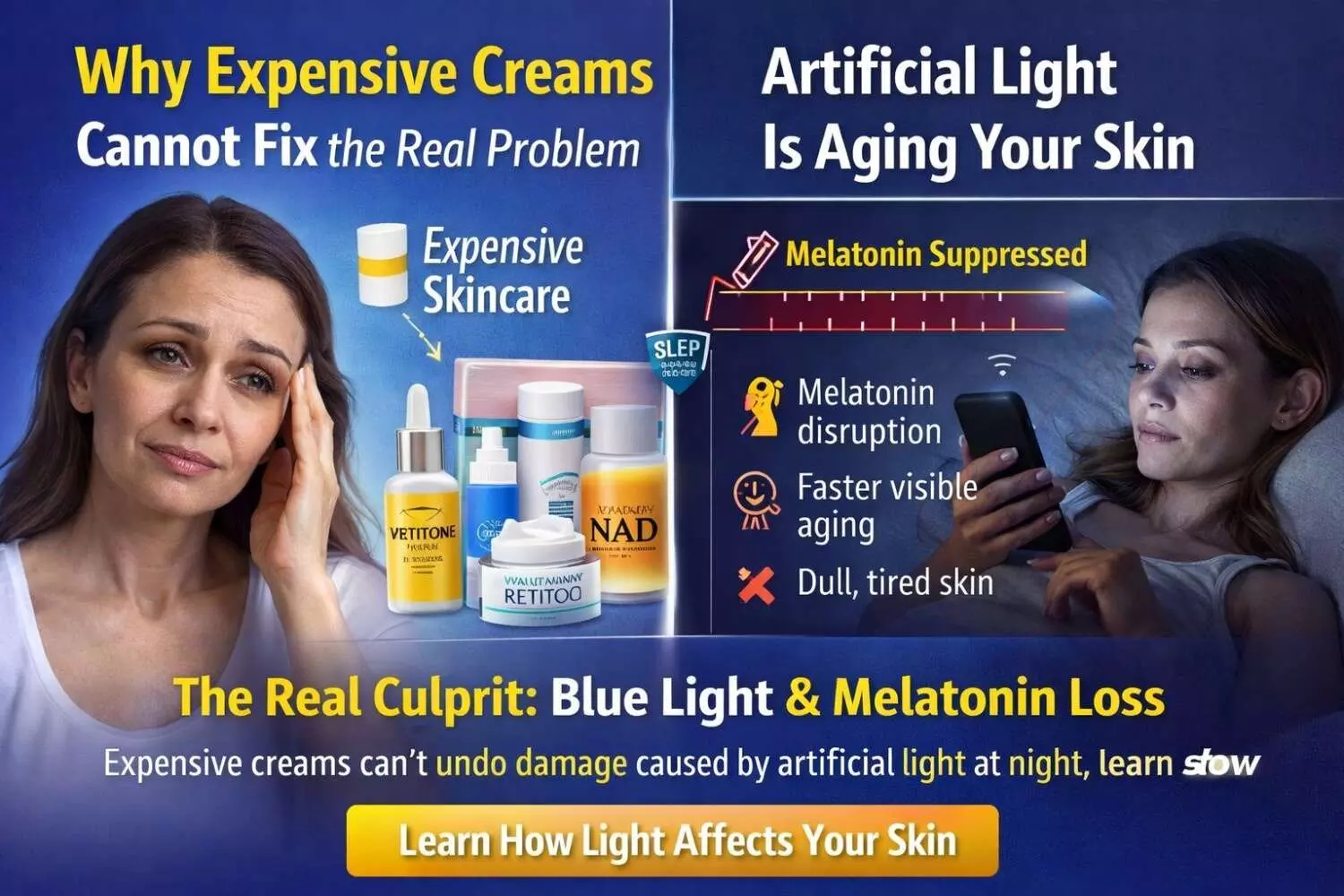
And Why Expensive Creams Cannot Fix the Real Problem
Last week, a woman in her mid-forties sat across from me and looked genuinely drained.
She had spent close to four hundred dollars that month on anti-aging products. Retinol. Vitamin C serums. Peptides. Collagen powders. NAD+ supplements. She was even researching Botox clinics.
“I’m doing everything right,” she said. “But my skin still looks tired. Dull. And I can’t shake this exhaustion.”
So I asked her two simple questions.
“What time do you usually go to sleep?”
“Midnight. Sometimes, one in the morning if I’m scrolling on my phone.”
“And do you use your phone in bed?”
She laughed. “Of course. How else am I supposed to unwind?”
What I told her was not a new product recommendation or a better routine.
It was this: those expensive creams were trying to repair damage that was still being created every night through artificial light exposure.
The beauty industry is great at selling fixes for what you can see. It talks far less about the conditions your skin needs in order to repair itself in the first place.
Because there is a basic biological repair cycle that should switch on every evening, when artificial light keeps interrupting that signal, no cream, supplement, or injectable can fully close the gap.
The answer is not another product. It is learning how skin actually restores itself and then supporting the environment that makes that restoration possible.
Skin Aging You Can See in the Mirror
You stand in front of the bathroom mirror in the morning.
The dark circles are still there. Fine lines look a little more obvious than they used to. Your skin has that muted look, like the brightness is turned down.
You have been consistent. You moisturize daily. You use retinol. You drink water. You take collagen. You bought the serum everyone recommends.
Yet the overall picture barely shifts.
After a while, it starts to feel personal. Like your skin is not responding. Like you are missing the one thing that works for everyone else.
So you begin to consider bigger steps. Injections. Procedures. More products.
But here is what most people are never told.
Your skincare products can only support repair. They cannot replace the body’s repair system when it is being suppressed night after night by artificial light.
The Damage You Do Not Notice Until It Adds Up
Most people understand UV exposure from the sun. What tends to be overlooked is how constant indoor blue light can affect skin over time.
A 2024 study (Journal of Investigative Dermatology) stated that unbalanced blue light from screens and LED lighting can penetrate the skin and activate pathways linked with DNA damage, inflammation, hyperpigmentation, and collagen breakdown.
A comprehensive review published in the Journal of Cosmetic Dermatology examined blue light exposure from indoor lighting and screens and noted effects tied to melanin disruption, increased oxidative stress, and a weaker skin barrier.
These are not abstract changes. Over time, they show up as uneven tone, earlier fine lines, and a kind of persistent dullness that is hard to “treat” with products alone.
Your laptop screen and overhead LEDs are not only tiring your eyes. They can contribute to visible skin aging.
But the bigger issue for most people is what happens when that light exposure continues into the evening.
The Nighttime Hormone Your Skin Depends On
Melatonin is often called a sleep hormone, but that description does not capture what it does.
Melatonin is also a powerful antioxidant your body produces naturally, and it supports nighttime repair.
While you sleep, melatonin is involved in processes tied to DNA repair, inflammation regulation, and protection from oxidative stress. It also supports the conditions that help skin maintain firmness, clarity, and even tone over time.
During the day, your skin collects stress. Light exposure. Environmental particles. Normal metabolic wear and tear.
At night, your body is meant to restore that load.
But only if melatonin is allowed to rise.
Artificial light after sunset suppresses melatonin production. Phone scrolling, television, bright overhead lighting, and even “normal” indoor LEDs can all tell your brain it is still daytime.
Less melatonin means less repair.
Over time, that imbalance adds up. Damage accumulates without full restoration. The result is faster visible aging, deeper lines, uneven pigmentation, loss of elasticity, and chronic dullness, even when your routine is expensive and consistent.
Clinical work published in the Journal of Pineal Research and follow-up reviews in 2023 and 2024 discuss melatonin’s role in skin protection and anti-aging repair.
Topical melatonin may help support the skin, but it cannot replace the internally produced melatonin your body makes in response to darkness.
You cannot serum your way out of a light problem.
The Truth Behind That Tired Face in the Mirror
The woman staring back at you in the mirror is not broken.
She is not failing at skincare. She is not “aging badly.”
She is trying to repair herself under conditions that make repair harder than it needs to be.
Artificial light at night blocks the very hormone your skin relies on to recover. No cream can compensate for that signal loss.
Your Skin Saving Light Strategy
You do not need to change your whole life. You need to restore the timing signals your body expects.
Morning
Get outside for natural light within thirty minutes of waking. On a sunny day, five to ten minutes is enough. On a cloudy day, aim closer to twenty.
This helps anchor your circadian rhythm, which supports healthier melatonin production later that night.
Daytime
If you work indoors, long hours under screens and LED lighting can add stress to both your nervous system and your skin.
VivaRays Daytime lenses are designed to harmonize artificial blue light while still allowing beneficial wavelengths to reach your eyes.
When you can, take light breaks. Step outside for a few minutes or sit near a window.
Evening
Two to three hours before bed, start taking melatonin.
Wear VivaRays Evening Circadian Glasses to block the blue wavelengths most associated with melatonin suppression.
Dim overhead lights and switch to warmer lamps under 3000K so your environment feels more like dusk.
Night
If you need to use screens close to bedtime, switch to VivaRays red lenses thirty to sixty minutes before sleep to block artificial light more completely.
Sleep in total darkness. Use blackout curtains and cover LED indicators. If full darkness is difficult, the VivaRays organic cotton blackout mask helps protect melatonin through the night.
Charge phones outside the bedroom whenever possible.
Consistency
Keep your sleep and wake time steady, even on weekends.
Take weekly photos in similar lighting so you can notice changes in tone, clarity, and under-eye darkness.
The Results Speak for Themselves
Three months after the woman from the beginning started protecting her melatonin and reducing artificial light at night, people began asking if she had work done.
Her skin looked brighter. The under-eye darkness softened. The dullness lifted.
She still uses her serums. The difference is that now her body is finally getting the nighttime conditions it needs to make those products worth using.
“I finally recognize myself in the mirror again,” she told me. “And I’m not spending hundreds of dollars chasing results anymore.”
You Are Not Broken. Your Light Environment Is.
Your body already knows how to create healthy, radiant skin. It has always been known.
For most of human history, life followed a simple rhythm: bright days, dark nights. That rhythm is still built into your biology.
What changed is not you. What changed is your environment.
And that part is fixable.
Morning light and evening darkness are not trends. They are basic signals your body expects.
You do not need another expensive product to fix your skin. You need the right light so your body can do what it already knows how to do.





