

Microsoft, Hexagon robotics mark milestone in humanoid commercial launch
Microsoft, Hexagon robotics mark milestone in humanoid commercial launch
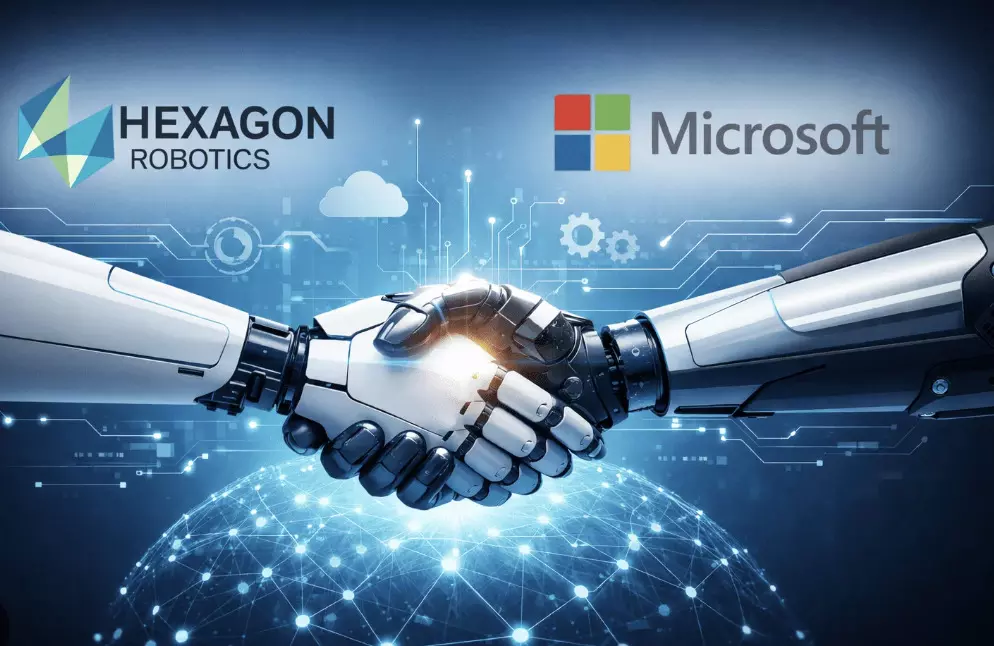
The partnership announced this week between Microsoft and Hexagon Robotics signals a turning point in the commercial rollout of humanoid, AI-powered robots in industrial settings. By combining Microsoft’s cloud and AI infrastructure with Hexagon’s robotics, sensor, and spatial-intelligence capabilities, the collaboration aims to accelerate the deployment of physical AI systems in real-world workplaces.
At the heart of the alliance is AEON, Hexagon’s industrial humanoid robot, engineered to operate autonomously in factories, logistics centres, engineering plants, and inspection environments. The companies say AEON is designed not as a research prototype, but as a deployable system for demanding, safety-critical industrial use.
The partnership will focus on multimodal AI training, imitation learning, real-time data management, and deep integration with existing industrial systems. Initial target sectors include automotive, aerospace, manufacturing, and logistics—industries already facing labour shortages and rising operational complexity that are beginning to constrain growth.
More broadly, the announcement reflects a maturing ecosystem in which cloud platforms, physical AI, and advanced robotics engineering are converging, making humanoid automation commercially viable for the first time.
Humanoid robots leave the lab
For decades, humanoid robots were largely confined to research institutions and technology demonstrations. Over the past five years, however, advances in perception, reinforcement and imitation learning, and access to scalable cloud infrastructure have pushed them into real working environments.
A prominent example is Agility Robotics’ Digit, a bipedal robot designed for logistics and warehouse operations. Digit has been piloted in live environments by companies including Amazon, where it handles material-movement tasks such as tote transport and last-metre logistics. These deployments typically aim to augment human workers rather than replace them, with robots taking on physically demanding or repetitive work.
Tesla’s Optimus programme has also moved beyond concept videos and into factory trials. The robots are being tested on structured tasks such as parts handling and equipment transport within Tesla’s manufacturing facilities. While still limited in scope, these trials underline a growing preference for humanoid or human-like robots that can operate in spaces built for people, without requiring wholesale redesign of facilities.
Inspection and hazardous environments lead adoption
Industrial inspection is emerging as one of the earliest commercially viable use cases for humanoid and quasi-humanoid robots. Boston Dynamics’ Atlas, while not yet a general-purpose commercial product, has been used in industrial trials and disaster-response scenarios, navigating uneven terrain, climbing stairs, and manipulating tools in environments unsafe for humans.
Similarly, the Toyota Research Institute has deployed humanoid platforms for remote inspection and manipulation tasks, often using multimodal perception and human-in-the-loop control. This reflects an industry-wide emphasis on reliability, traceability, and safety, with human oversight remaining essential in early deployments.
Hexagon’s AEON fits squarely into this pattern. Its focus on sensor fusion and spatial intelligence makes it particularly suited to inspection, quality assurance, and maintenance tasks, where accurate understanding of physical environments matters more than conversational AI capabilities.
Cloud platforms underpin robotics at scale
A defining element of the Microsoft–Hexagon partnership is the role of cloud infrastructure in scaling humanoid robotics. Training and operating physical AI systems generates vast amounts of data, including video streams, force-feedback signals, spatial maps from LIDAR, and operational telemetry. Historically, processing and storing this data locally has been a major constraint.
By leveraging platforms such as Azure and Azure IoT Operations, humanoid robots can be trained, updated, and monitored at fleet level rather than as isolated machines. This enables shared learning, faster iteration, and greater consistency across deployments. For enterprise buyers, it also means humanoid robots can increasingly be managed like software assets, rather than traditional industrial machinery.
Labour shortages accelerate interest
Demographic trends in manufacturing, logistics, and asset-heavy industries are becoming increasingly challenging. Ageing workforces, skills shortages, and declining interest in manual roles are creating gaps that conventional automation struggles to fill. Fixed robotic systems work well for predictable, repetitive tasks, but lack flexibility in dynamic, human-centred environments.
Humanoid robots sit between traditional automation and human labour. Rather than forcing workflow redesign, they can stabilise operations where workforce availability is uncertain. Early deployments show value in night shifts, peak-demand periods, and hazardous tasks that companies struggle to staff safely.
What boards should consider
Real-world pilots have highlighted several factors for decision-makers evaluating humanoid robotics investments. Successful deployments prioritise task-specific use cases over general intelligence. Data governance and cybersecurity remain critical, particularly when robots are connected to cloud platforms.
Perhaps most challenging is workforce integration. While sourcing and deploying the technology is increasingly feasible, gaining employee trust and acceptance requires careful change management. Human oversight also remains essential for safety, compliance, and regulatory approval.
A gradual but irreversible shift
Humanoid robots are not about to replace human workers. But evidence from live deployments and factory trials suggests they are steadily entering the workplace, performing economically valuable tasks and integrating with existing industrial systems.
For organisations with the appetite to invest, the strategic question may no longer be if humanoid robots will be adopted—but when, and whether competitors will deploy them first, responsibly and at scale.





