

Hiring Bust: Why India’s IT giants added just 17 employees in nine months?
Indian IT firms added just 17 net employees in nine months as AI-driven automation, shrinking benches, and a shortage of AI-ready talent redefine hiring models.
AI demand soars, hiring slows to a crawl
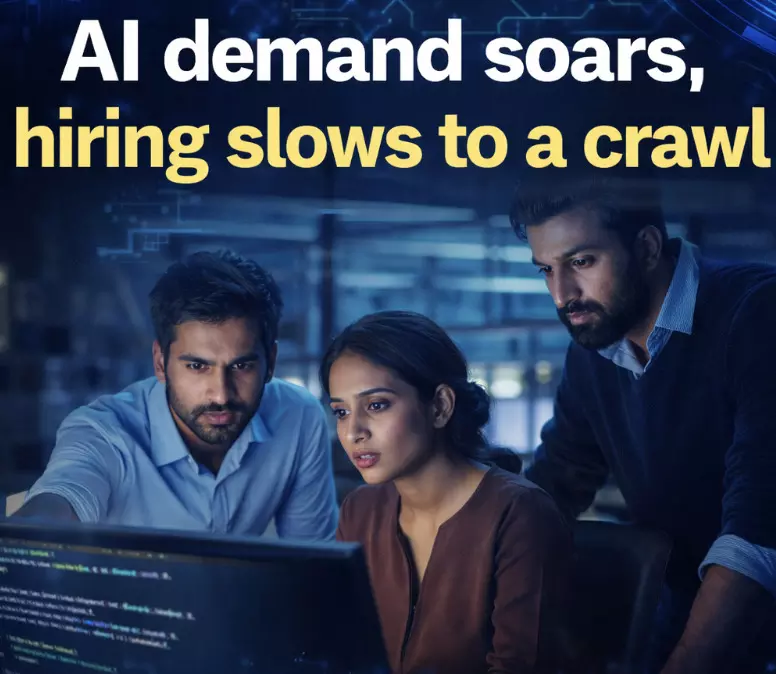
India’s top IT services firms are facing a paradox: soaring client demand for generative AI alongside near-zero net hiring. Automation, shrinking benches, and an acute shortage of AI-ready talent are reshaping workforce strategies across the sector.
India’s IT services industry, long synonymous with large-scale hiring and steady workforce expansion, is undergoing a profound structural shift. Despite an explosion of client interest in generative AI and automation-led transformation, the country’s top five IT services firms added just 17 net employees in the first nine months of FY26. In the same period last year, these companies had added 17,764 employees, underscoring how dramatically the hiring engine has slowed.
This stark contrast highlights a new reality: AI-era productivity is allowing companies to deliver more with fewer people. According to Chirag Mehta, vice president and principal analyst at Constellation Research, the numbers reflect “more output per employee, fewer benches, and tighter utilization.” What once required large, layered teams can now be achieved with leaner, more specialized groups supported by automation and AI tools.
A Severe Shortage of AI-Ready Talent
Ironically, the hiring slowdown is not due to a lack of demand but rather a shortage of the right skills. While enterprises are eager to deploy AI across software development, operations, and business processes, the supply of qualified talent is lagging far behind.
Biswajeet Mahapatra, principal analyst at Forrester, points out that India currently has only one qualified engineer for every ten generative AI jobs. Even within IT services firms, just 15–20% of the workforce is considered AI-ready, a figure constrained by rapidly evolving technologies, limited advanced research exposure, and intense salary inflation for niche AI skills.
As a result, companies are cautious about mass hiring, preferring targeted recruitment, internal redeployment, and reskilling rather than expanding headcount indiscriminately.
Headcount Trends Reveal the Shift
The impact of this transformation is clearly visible in the Q3 FY26 earnings of India’s leading IT services firms. Tata Consultancy Services (TCS), the country’s largest IT employer, reported a global headcount of 582,163 at the end of Q3—down by more than 11,000 employees sequentially and sharply lower than its Q1 level of over 613,000.
Tech Mahindra also saw a decline, with headcount falling to 149,616 from 152,714 in the previous quarter. HCLTech reported a marginal dip of 0.1%, ending Q3 with 226,379 employees.
Infosys stood out as a partial exception, adding nearly 5,000 employees sequentially to reach 337,034. However, even Infosys’ growth was significantly lower than in earlier periods, signaling that it too is grappling with the same constraints around talent availability and relevance.
AI Redefines the Traditional Delivery Model
For decades, Indian IT firms built their global success on a labor-arbitrage model that emphasized large teams, predictable delivery, and cost efficiency. AI is now fundamentally challenging that model.
“By leveraging AI and machine learning, companies are automating high-volume, routine tasks that earlier required large teams,” said Biswajit Maity, senior principal analyst at Gartner. This shift is pushing firms toward smaller, more specialized teams and contracts that are increasingly outcome-based, tied to key performance indicators rather than effort or headcount.
In software development in particular, AI-powered tools and so-called “vibe coding” are dramatically boosting developer productivity. Jimit Arora, CEO of Everest Group, noted that organizations can now push significantly more code into production with a fraction of the traditional workforce.
From Human-Heavy to Tech-Heavy
The balance between human effort and technology is also changing rapidly. According to Arora, the traditional IT delivery model was roughly 80% human and 20% technology. The reinvention model flips this ratio, moving toward 20% human and 80% technology. In practical terms, the industry is likely to settle around a 50-50 balance, where AI and automation handle repetitive and scalable tasks, while humans focus on design, governance, and complex decision-making.
This evolution explains why hiring volumes remain muted even as deal pipelines stay healthy. AI is not eliminating teams altogether, but it is reducing the need for large benches and excess capacity.
Hiring Gives Way to Reskilling
Instead of aggressive hiring, IT services firms are channeling investments into reskilling and upskilling their existing workforce. Earnings calls from the October–December quarter consistently highlighted training initiatives as a strategic priority.
TCS, for instance, disclosed that it now has over 217,000 employees with advanced AI skills, a three-fold increase compared to last year. At the same time, the company acknowledged that where redeployment was not feasible, workforce reductions did occur—around 1,800 employees were let go in Q3 alone.
HCLTech is also scaling AI adoption across its business lines. The company has trained over 38,000 employees on generative AI and more than 600 on responsible AI, according to CEO C. Vijayakumar. These efforts are aimed at embedding AI capabilities deeply into customer engagements rather than building standalone AI teams.
Rise of Subcontracting and Gig Models
Another less visible factor behind stagnant headcount numbers is the growing reliance on subcontracting and gig-style capacity. As Chirag Mehta observed, IT services firms are increasingly turning to flexible talent pools to meet variable demand instead of maintaining large permanent benches.
This approach allows companies to scale delivery up or down without reflecting significant changes in on-roll employee numbers. While delivery volumes may rise, headcount growth remains flat or even negative, reinforcing the perception of a hiring slowdown.
A New Workforce Reality for Indian IT
The addition of just 17 net employees over nine months is not a temporary anomaly—it is a signal of a deeper structural change in India’s IT services industry. AI-driven automation, outcome-based contracts, and a scarcity of specialized talent are converging to redefine how work gets done.
For professionals, this means future relevance will depend less on generic technical skills and more on AI fluency, domain expertise, and adaptability. For companies, success will hinge on how effectively they can reskill their workforce and integrate AI into delivery models without eroding trust or quality.
As generative AI adoption accelerates globally, India’s IT giants are proving that growth in the AI era does not necessarily translate into growth in headcount. Instead, it marks the rise of a leaner, more technology-driven workforce—one where productivity, not payroll size, defines competitiveness.





