

Global tech leaders are betting big on India’s AI mission | Davos 2026
At Davos 2026, global tech leaders back India’s AI Mission for its scale, talent, infrastructure and real-world use cases, positioning India as a global AI platform.
India’s AI mission | Davos 2026
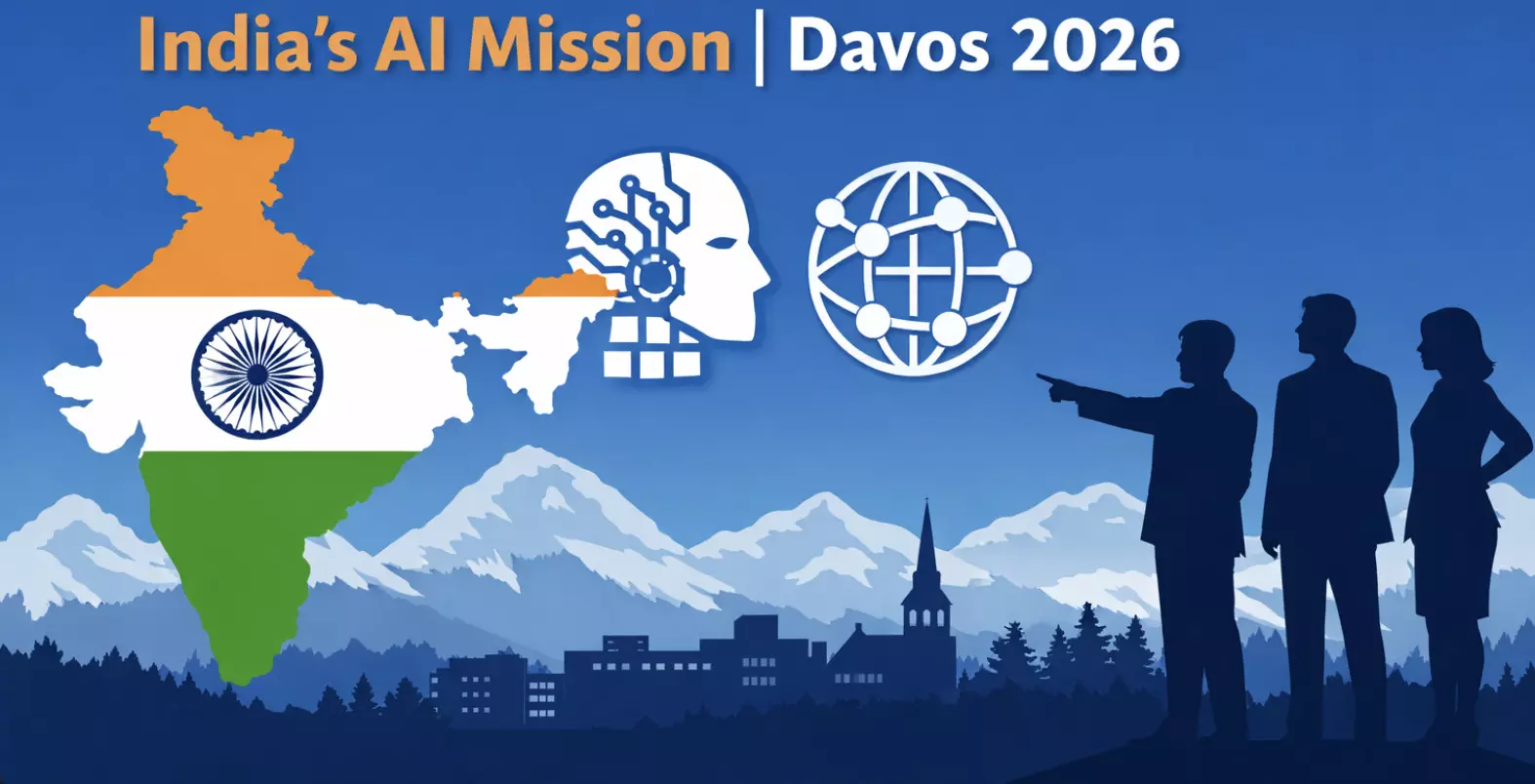
At Davos 2026, India’s AI Mission emerged as a global focal point, with tech leaders and investors backing the country’s scale, talent, and real-world use cases—positioning India not just as a market, but as a global AI platform.
India’s artificial intelligence ambitions took center stage at the World Economic Forum Annual Meeting 2026 in Davos, as global technology leaders, investors, and policymakers rallied behind the country’s rapidly expanding AI ecosystem. In a conversation with Business Today Group Editor Siddharth Zarabi, Abhishek Singh, CEO of the India AI Mission and Additional Secretary at the Ministry of Electronics and Information Technology (MeitY), outlined why India is increasingly seen as a critical force in shaping the future of artificial intelligence worldwide.
According to Singh, India’s appeal lies in a rare convergence of scale, infrastructure, talent, and real-world relevance. Unlike many advanced economies where AI adoption is often confined to enterprise or niche use cases, India offers a massive and diverse user base that enables AI solutions to be tested, refined, and deployed at population scale. This ability to build and validate AI systems in complex, real-world environments is drawing global interest.
One of the strongest signals of confidence has been the surge in investments into India’s digital and AI infrastructure. Singh highlighted record commitments toward data centres, cloud capacity, and high-performance compute resources, which are foundational for training and deploying advanced AI models. These investments, he said, are creating the backbone for India to move beyond being a consumer of AI technologies to becoming a creator of globally competitive AI solutions.
Talent remains another decisive advantage. India’s deep pool of engineers, data scientists, and researchers—combined with a fast-growing startup ecosystem—has positioned the country as a preferred destination for AI research and product development. Global firms are increasingly setting up AI labs and innovation hubs in India, not just for cost efficiencies, but to tap into problem-solving talent that understands large-scale, real-world challenges.
Singh also emphasized that India’s AI push is strongly anchored in practical use cases. From agriculture and healthcare to education, governance, and financial inclusion, AI applications in India are being designed to solve fundamental development challenges. This focus on impact-driven innovation is resonating with global leaders who see India as a testing ground for scalable AI solutions that can later be adapted for other emerging markets.
A key theme discussed at Davos was India’s approach to responsible and inclusive AI. Singh noted that the India AI Mission is being built with strong emphasis on ethics, transparency, and trust. Rather than pursuing AI purely for commercial gains, India is positioning itself as a champion of “AI for public good,” ensuring that technological progress does not widen social or economic inequalities.
This philosophy will take center stage at the upcoming India AI Impact Summit in New Delhi. Singh described the summit as a landmark global gathering focused on the Global South, bringing together governments, industry leaders, researchers, and civil society. The goal is to shape global AI frameworks that reflect the needs of developing economies, rather than adopting one-size-fits-all models designed by advanced nations.
As discussions at Davos made clear, global tech leaders are no longer viewing India merely as a fast-growing market. Instead, they see it as a foundational platform for building, deploying, and governing AI at scale. With its combination of infrastructure, talent, policy vision, and societal impact, India’s AI Mission is increasingly shaping the global conversation on how artificial intelligence should evolve in the years ahead.





