

Budget 2026 bets on India’s AI technology and talent push
Budget 2026 maps India’s AI future with semiconductor expansion, data centres, school AI labs, fellowships and skilling for talent at the centre of tech growth.
India’s AI Ambition
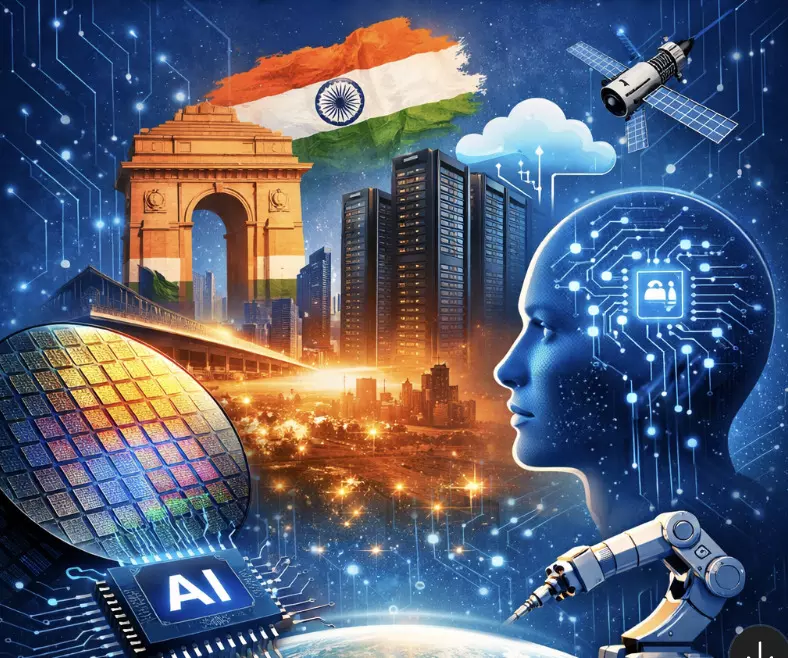
The Union Budget 2026 has outlined an ambitious roadmap for transforming India into an AI-driven economy, combining large-scale investments in semiconductors and digital infrastructure with a decisive push toward education, research, and workforce skills. The underlying message is clear hardware alone will not secure technological leadership; human capital will determine impact.
Technology Strategy Anchored in People
This year’s Budget positions artificial intelligence at the heart of India’s long-term economic strategy. While industrial policy and capital expenditure remain central, policymakers have acknowledged that infrastructure without skilled talent risks underutilisation.
The government’s approach therefore advances on two parallel tracks: expanding advanced technology capacity while accelerating AI literacy and workforce readiness across the population.
Semiconductors and Data Centres: Strengthening the Digital Core
On the infrastructure front, the government has expanded its semiconductor ambitions through the launch of India Semiconductor Mission (ISM) 2.0. The programme now goes beyond assembly and testing to include chip design, equipment manufacturing, and deeper domestic supply-chain capabilities. The move reflects India’s goal of reducing external dependence while building resilience in a sector critical to AI, electronics, and advanced manufacturing.
Data infrastructure is another major focus. The Budget introduces policy support and extended tax incentives for foreign firms using India-based data centre services, aimed at attracting global cloud providers and hyperscale operators. The objective is to position India as a key global hub for data storage, processing, and AI deployment.
Private-sector momentum supports this strategy, with major global technology companies announcing multi-billion-dollar investments in India’s cloud and AI infrastructure. Together, semiconductor capacity and data centres form the physical backbone required for large-scale AI adoption.
Bridging the Skills Gap: The Human Capital Push
A defining feature of this year’s AI roadmap is its strong emphasis on education and skilling.
The Budget proposes the establishment of 15,000 AI labs in schools, introducing AI awareness and computational thinking at an early stage. This signals a shift from elite, higher-education-driven innovation toward a broad-based talent pipeline.
At the advanced research level, the government plans to fund 10,000 technology fellowships at premier institutions, including the IITs. These fellowships aim to strengthen deep-tech research and innovation, helping India move up the value chain from service delivery to technology creation.
Recognising AI’s transformative impact on jobs and industries, the government will also set up a high-powered panel to assess how artificial intelligence will reshape employment patterns, services, and skill needs. The aim is to anticipate transitions rather than respond after disruption occurs.
Further reinforcing this direction, allocations to the Ministry of Skill Development and Entrepreneurship (MSDE) have increased, with a focus on demand-linked training and sector-specific programmes. The emphasis is on practical, job-ready capabilities that enable workers to operate and optimise intelligent systems across manufacturing, services, and digital industries.
AI Push Within a Balanced Economic Framework
These initiatives come against the backdrop of strong projected growth for FY26, driven largely by the services sector. At the same time, the government continues to pursue fiscal consolidation while maintaining elevated capital expenditure.
Public capex remains a cornerstone of strategy, reflecting the belief that infrastructure — both physical and digital — will crowd in private investment and enhance long-term productivity. The semiconductor and AI agenda also aligns with broader goals of strengthening manufacturing, diversifying exports, and integrating India more deeply into global value chains.
In a global semiconductor environment marked by intense competition and geopolitical sensitivity, India is seeking to build its niche through incentives, domestic capability development, and the scale of its market.
The Central Thesis: Talent as the Multiplier
At its core, Budget 2026’s AI strategy rests on a simple premise: infrastructure enables, but people multiply impact. Advanced fabs, data centres, and cloud networks can only drive economic transformation if backed by a workforce capable of designing, deploying, and managing AI systems.
By linking semiconductor policy, digital infrastructure, school-level AI exposure, research fellowships, and large-scale skilling, the government is attempting to build a full-stack ecosystem — from classrooms to cleanrooms.
The success of this strategy will ultimately depend on execution. If implemented effectively, India could evolve from merely hosting technology infrastructure to becoming a global centre for AI innovation.





